Time Crisis 30th Anniversary Complete Series Retrospective
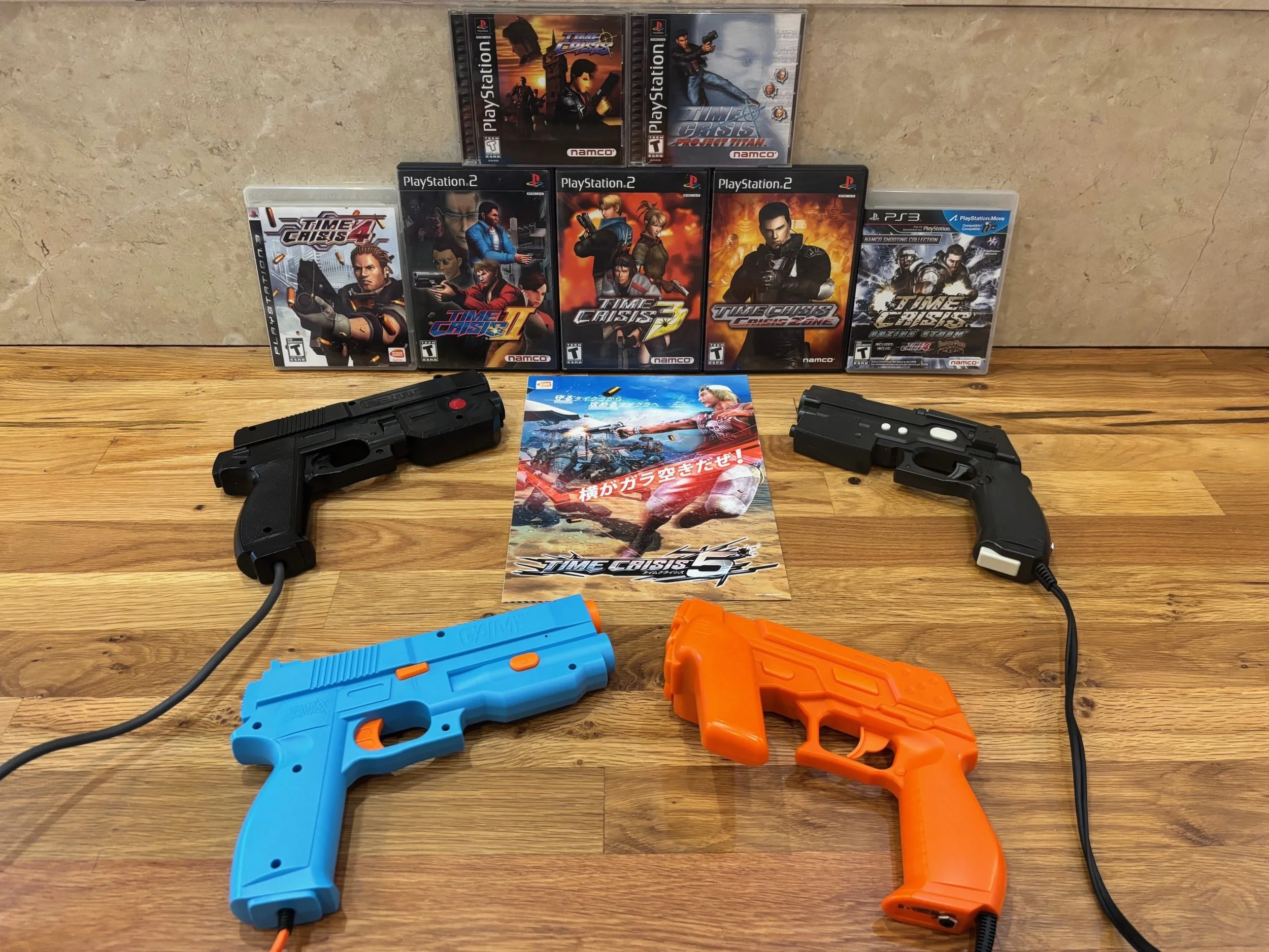
Thirty years ago this month, back in December of 1995, Namco released the first Time Crisis, which would go on to birth one of the most popular and influential light gun series of all time, inspiring decades of sequels and imitators, and changing the world of light gun games forever. Since we’ve just passed its 30th anniversary, now felt like the right time to go back and assess the entire series and its history to celebrate the occasion, taking a look at all the twists and turns the series went through in its attempt to keep relevant with the ever-changing gaming industry.
Having recently re-played every game in the series, we’ll be taking the approach of looking at each game chronologically, covering the hits and misses along the way, and discussing what each game brought to the table with a fresh perspective. To set the stage for the beginning of this saga, we need to go back in time to the arcade market of the early 1990s.
Time Crisis (1995)
In the early 1990s, fully 3D rendered arcade games were still becoming a slowly emerging technology, and 3D light gun style games were even more rare, with only a small handful of games that could technically fit into this category as of 1995. A few of them were Namco’s own light gun-adjacent 3D cockpit-based rail shooters like Solvalou and Starblade, released in 1991, and Galaxian 3 in 1993. These games are all borderline cases, since they all used an analog flight stick for the aiming instead of a light gun that interacted with the CRT tube (though Starblade and Galaxian 3’s were disguised as gun turrets,) plus Galaxian 3 only rendered its enemies in 3D, while the background played an FMV image from a Laserdisc, but you could still say they were, by definition, 3D shooting games.
The other fully 3D light gun games from this era that were much closer to Time Crisis in gameplay were the games in Sega’s Virtua Cop series, with the first releasing in September of 1994, plus its sequel in September of 1995, and these ones had a much bigger impact on the arcade market at the time. After the success of Sega’s new franchise, the teams at Namco started looking into following suit with their own fully polygonal light gun shooter that featured its own unique gameplay mechanics, which would ultimately release in the form of Time Crisis in December of that year, just three months after Virtua Cop 2.
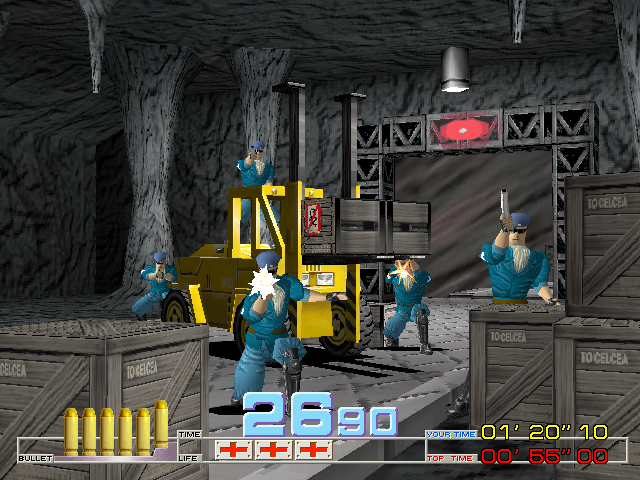
Time Crisis arcade gameplay.
The result was a game that swept arcades across the world and became a resounding hit, catching high revenues and great reviews from across the globe, with many praising its unique time-based mechanics as well as the cover and reload system controlled by a pedal, adding a tactical element not seen before in the genre. The game clearly drew its inspirations from the action movies of the 80s and 90s, with fast-paced action gameplay and a driving soundtrack that kept the excitement high as you shot your way through Richard Miller’s rescue mission.
The mechanics begged for many replays to master the mechanics and get better times, not too dissimilar to getting better lap times on a racing game, which motivated players to compete for top spots on the in-game time rankings leaderboard. The game offered time extensions as a reward for quick reflexes and taking enemies down as fast as possible, which encouraged players to practice and hone their reflexes not only to be able to post the highest scores on the machine, but also to keep extending the value of their money, since those extensions meant more time playing the game without putting in extra coins.
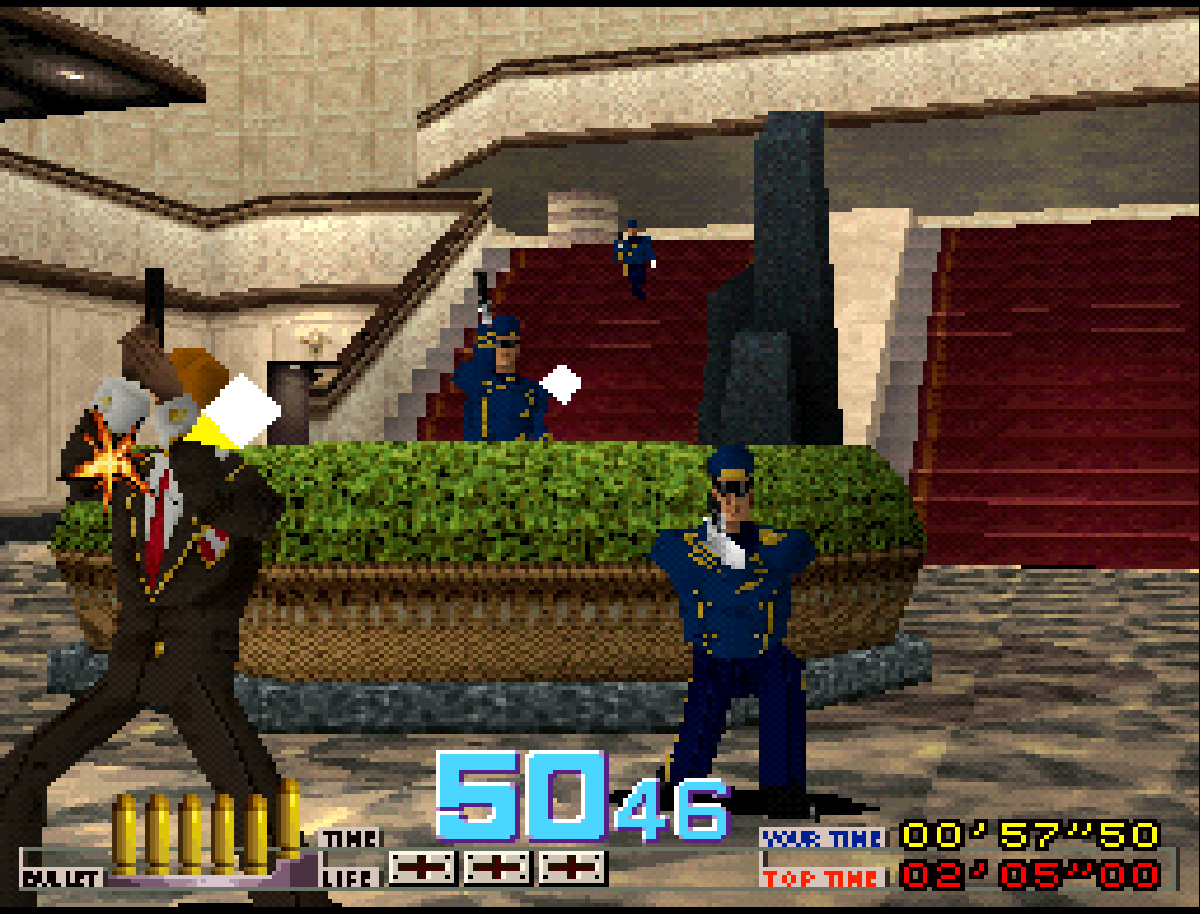
The PlayStation port’s extra campaign, dubbed Special mode.
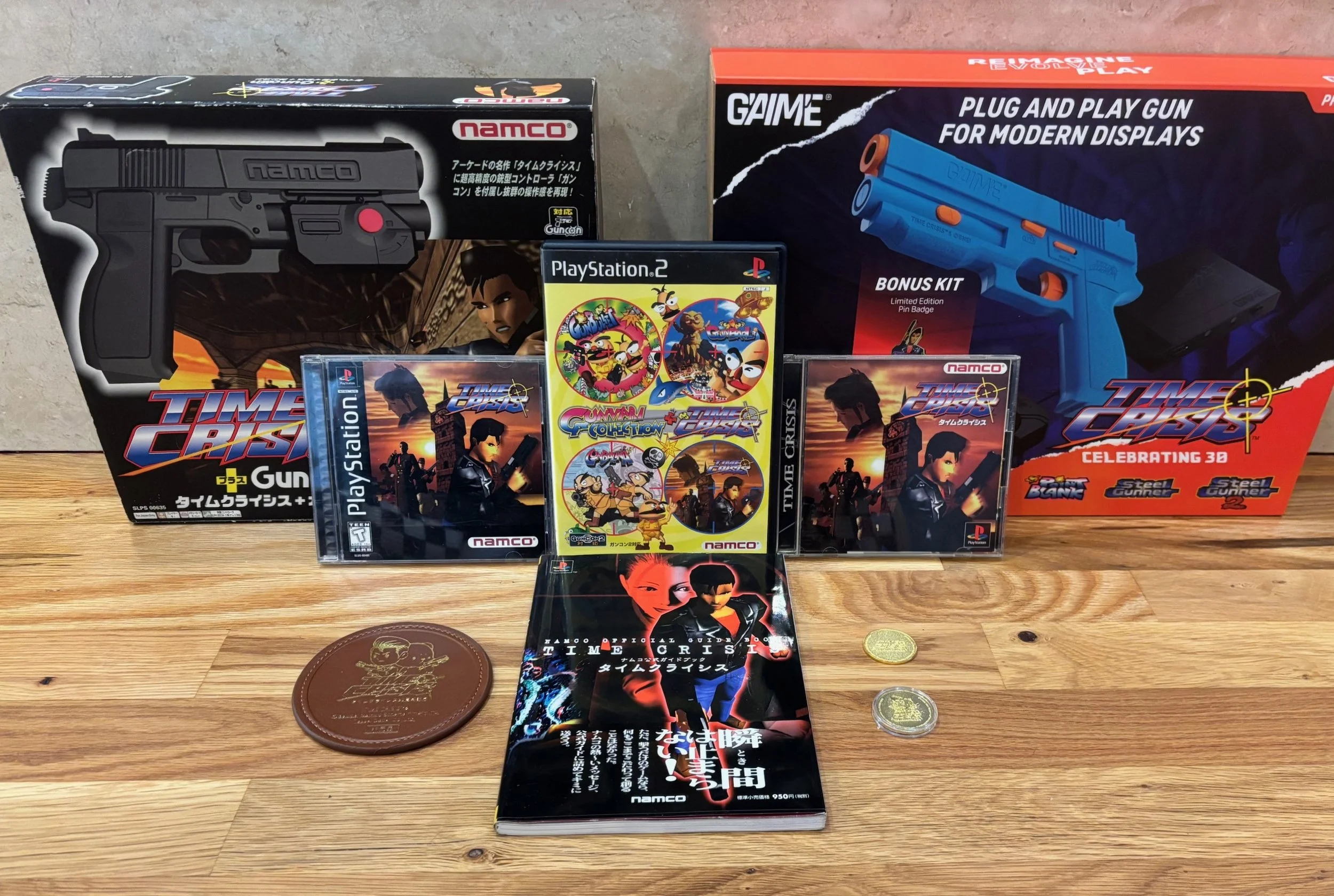
The first Time Crisis has ended up being ported to many different consoles and forms over the years, including the original PlayStation, PlayStation 2, a dedicated Arcade1Up machine, and just as of this year, the G’AIM’E Plug & Play gun system. The PlayStation port of the game suffered some visual downgrades, but also included a whole extra campaign in addition to the original arcade scenario, bringing Miller on another mission, which ended up being a similar length as the arcade scenario, but with new locations, enemies, and story.
Aside from its several ports, it also spawned a franchise that spans 11 games across 30 years, which began with our next subject, Time Crisis II.
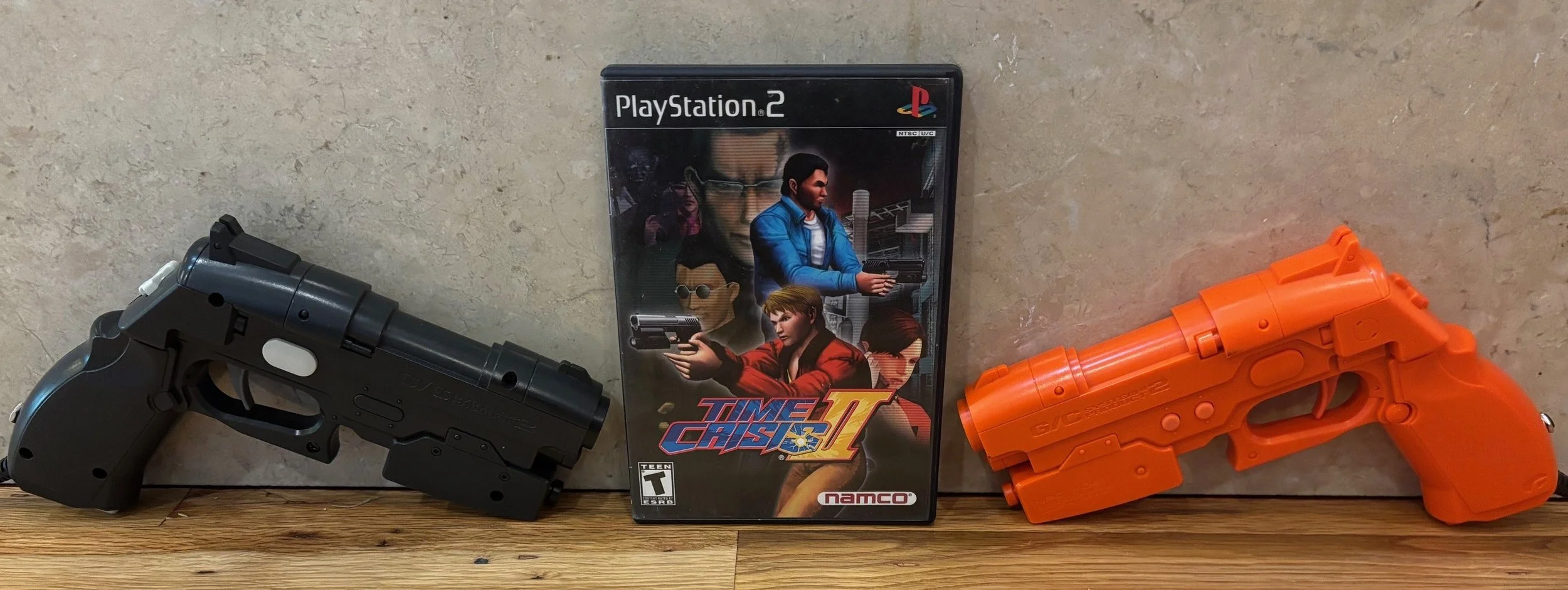
Time Crisis II (1997)
Time Crisis II was released just two years after the release of the first game, running on a slightly newer Namco arcade board than the first game, which allowed for some upgraded visual fidelity, and the game design generally strived to improve and perfect the formula they had established with the first Time Crisis. However, TCII also ended up innovating in another important way, since the game now allowed for two-player co-op play, with each player having their own monitor, gun, and pedal on the 2-player version of the cabinet.
This allowed players to choose one of the two new main characters in their adventures across the world to complete their V.S.S.E. missions, with each player playing slightly different versions of the game, featuring different camera angles and routes through each stage, making for a unique and varied co-op experience. The gameplay itself managed to feel even tighter and snappier than the first game, with faster action, more intense boss encounters, an even more exciting campaign, and some small quality of life changes that made it even easier and more intuitive to play.
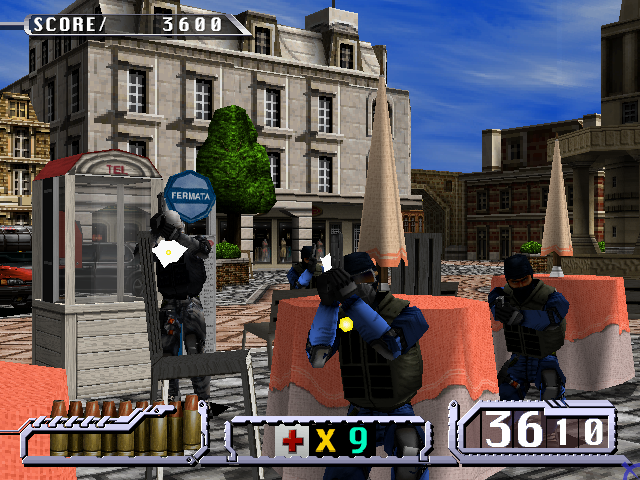
Time Crisis II arcade gameplay.
The port of Time Crisis II that made its way to the PlayStation 2 is generally considered one of the best home ports of any light gun game, where it not only improved the graphics and sound above what the arcade cabinet was able to do, but it added tons of extra modes and options. These include a challenge-based mission mode called Crisis Mission, which became a staple of the series going forward, and which even includes a showdown with Richard Miller himself, if you can finish all of its hardest challenges. It also included training modes, a dual-gun single player mode, and ports of some of Namco’s old mechanical light gun shooting titles like Shoot Away and Quick & Crash.
The PS2 version even included a way to play the game in co-op mode, almost exactly as in the arcade, where each player has their own monitor, even though it required two consoles, two TVs, and a special link cable. You can see a photo example of the home co-op setup I did myself below, and it’s an amazing experience if you have the equipment for it, as it essentially replicates the two player arcade machine in your home. The two-player mode can also be played with one TV, but the result is each player’s screen being crunched down to about 1/4 the size it’s supposed to be, which nearly kills the experience and your accuracy entirely.
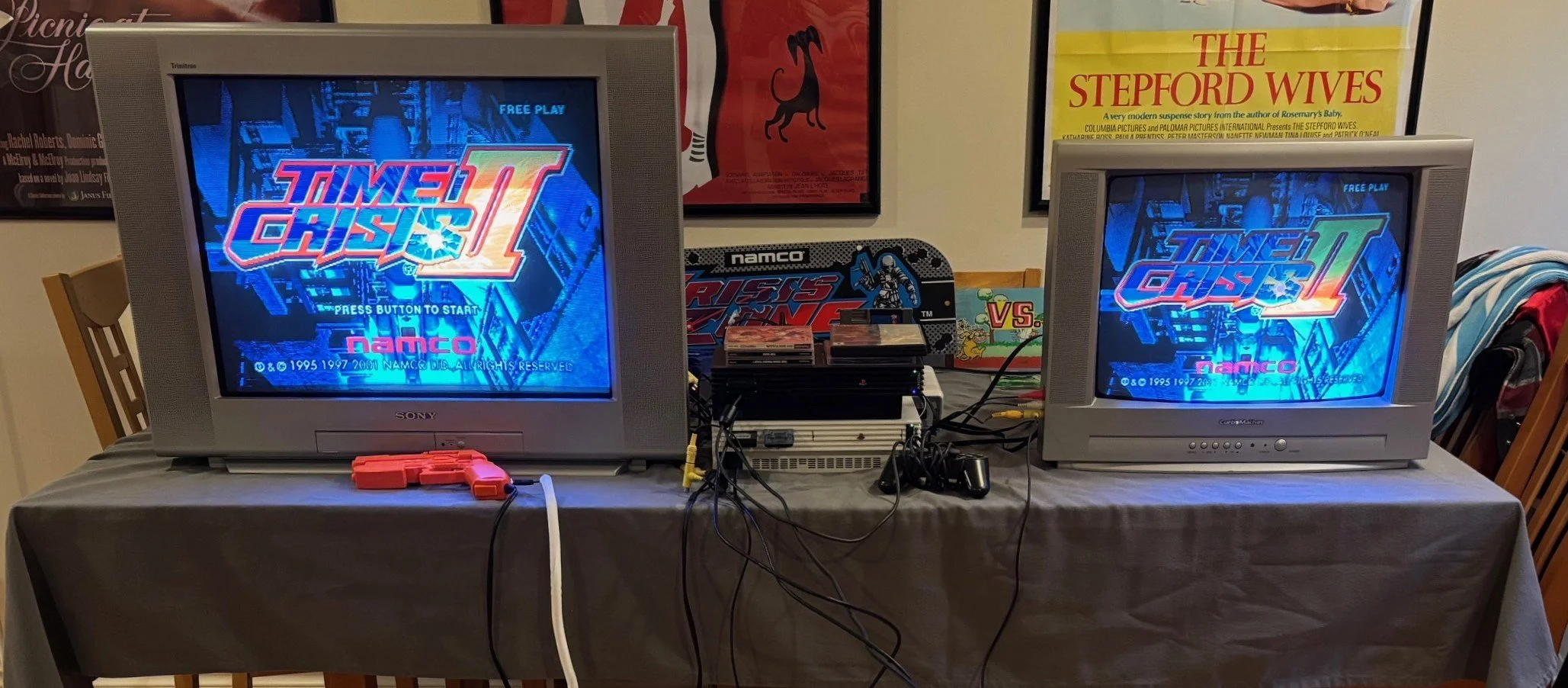
The link play setup on the PS2 port of Time Crisis II, replicating the arcade co-op experience.
TCII is one of the shining examples of what the genre was able to achieve in its era, and it served as one of the last “pure” Time Crisis experiences, since most of the entries that followed it started to move away from the relative simplicity of the first two games, starting with the first spin-off game in the series, Crisis Zone.
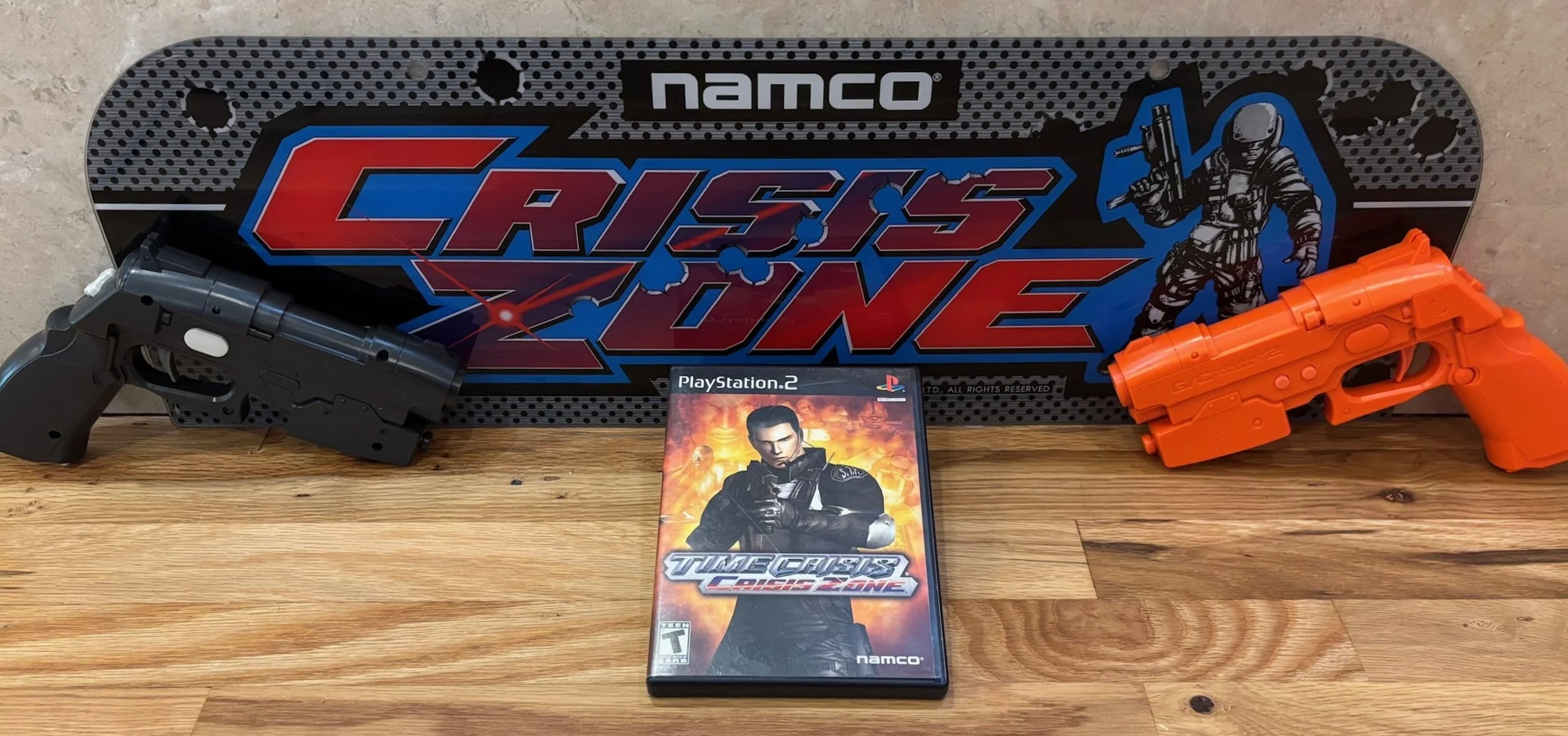
Crisis Zone (1999)
Crisis Zone marks the first major departure from the now-established formula of the first two games, being the first spin-off in the series, and featuring a lot of major changes in the design philosophy and core features. The arcade version ran on a nearly identical arcade system as Time Crisis II, so the visuals felt pretty similar to that game, and they oddly chose to go back to a single player-only experience with the arcade cabinet, despite TCII having implemented co-op play two years before. Another major change was that instead of featuring a pistol for the light gun’s shape, it included a machinegun instead, to reflect the new standard in-game weapon, and the foot pedal now operated a mobile ballistic shield that came up in your field of view to block attacks instead of using it to operate stationary cover points.
Some segments now allowed you to move and shoot at the same time, while controlling the speed of your walking with the shield mechanic, which allowed the game to maintain a faster pace, since holding up the shield only slowed down your walking speed and didn’t entirely stop you from moving. On top of the increased speed that this mechanic allows, it also introduced the feature of standard enemies having life bars instead of being the quick one-shot kills like the previous games. Since your new standard weapon was a fully automatic machine gun, this allowed you to deal a steady stream of damage by holding down the trigger instead of the tight precision of a single-shot handgun that was required to excel in the previous games.
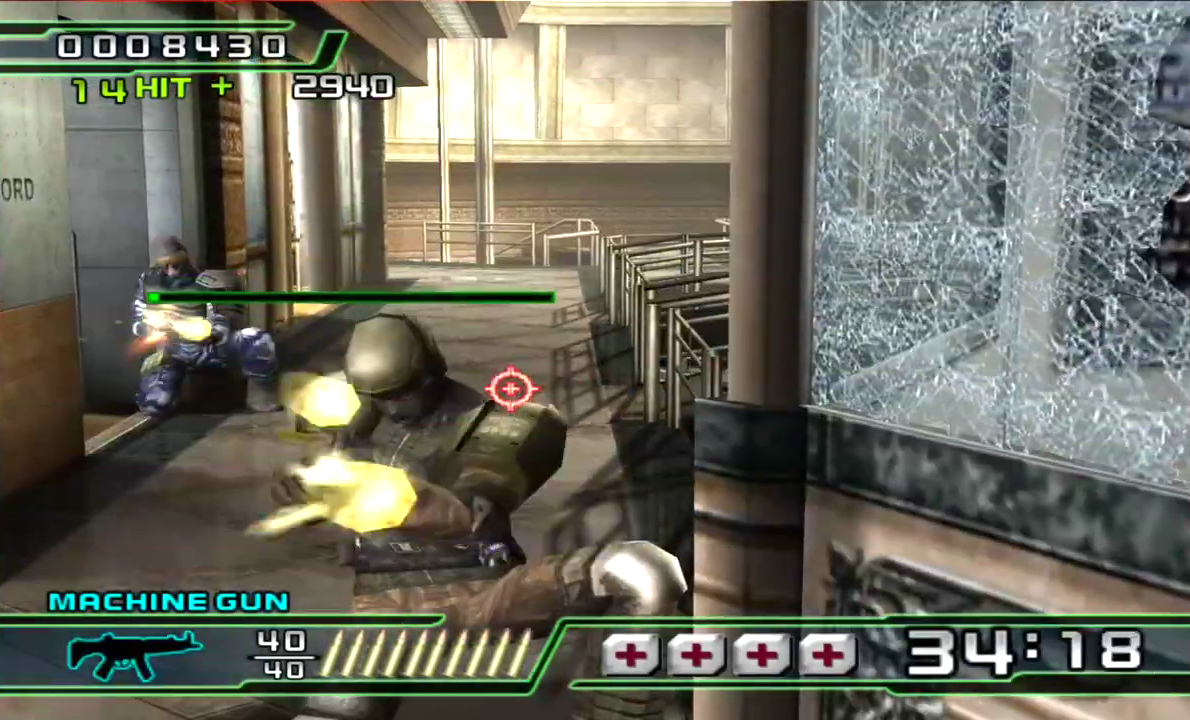
Crisis Zone’s shopping mall stage, from the PS2 port, showcasing the graphical upgrades with the broken glass physics.
This changed the flow of the game, which made it feel more action-packed and had a few bigger set pieces than the previous games, but it lost a bit of its wonderful simplicity in this innovation. It’s still a very strong game overall, even if it marked the end of the relative simplicity of the gameplay in the arcade titles going forward. Crisis Zone also put a big focus on destructible elements in every environment, making for an impressive visual feat for its time, and adding a little extra immersion in its world, since it made it feel like the spray of your machine gun was more powerful than ever.
Nearly five years after its arcade release, a port for the PlayStation 2 was released, which changed the title to Time Crisis: Crisis Zone, while also greatly upgrading the visuals, adding in tons of new features, and doubling the amount of stages available. One of the new modes was an alternate arcade mode that featured new difficulty balancing for the original arcade stages, as well as three new stages, and many different weapon types to switch between on the fly, including the whole arsenal from Time Crisis 3’s arcade version, plus a few weapons not found in TC3.
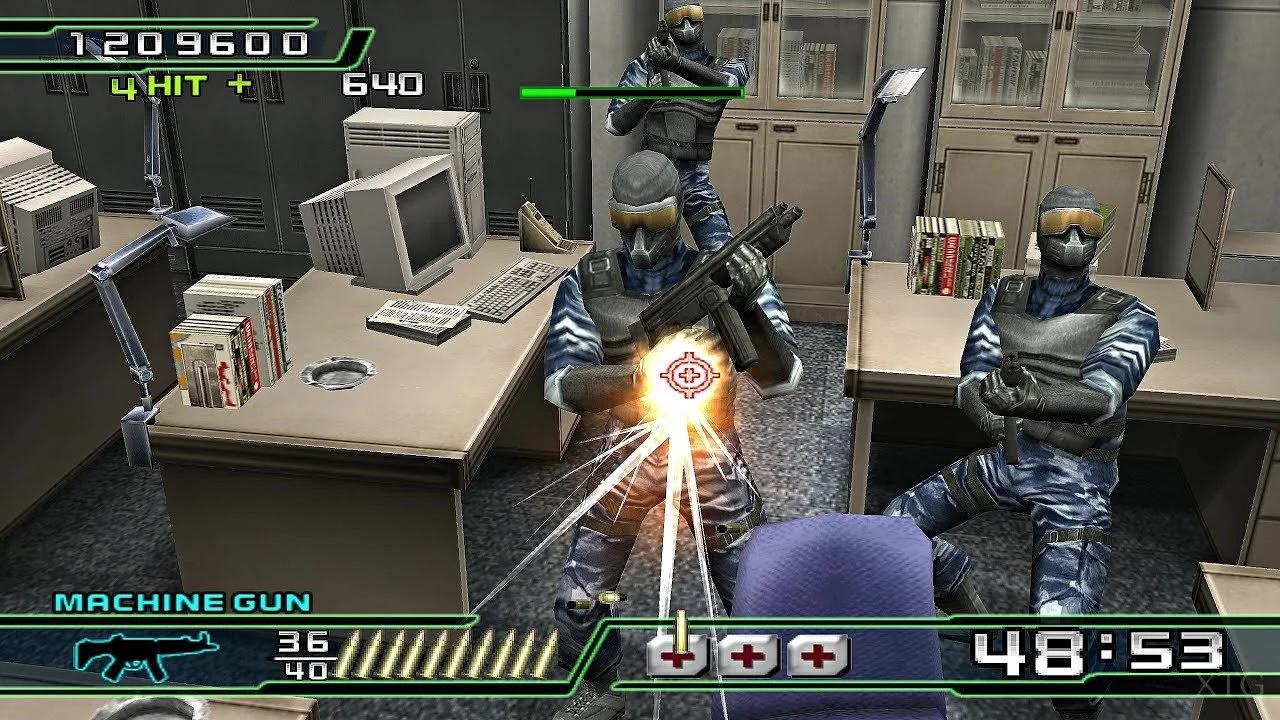
Crisis Zone PS2 port gameplay.
The port also added the Crisis Mission mode that first debuted in TCII and an unlockable double gun mode that allowed you to use two guns, which was not possible at all in the arcade version. This does allow you to approximate what Crisis Zone would be like with two players, but since the double gun mode still only features one shield, it doesn’t exactly function as a true two player mode.
Crisis Zone was an interesting step forward in expanding the franchise that pushed some of the game mechanics forward, and is still a lot of fun to play today, even past simply seeing how some of its mechanics became staples for the series long into the future.
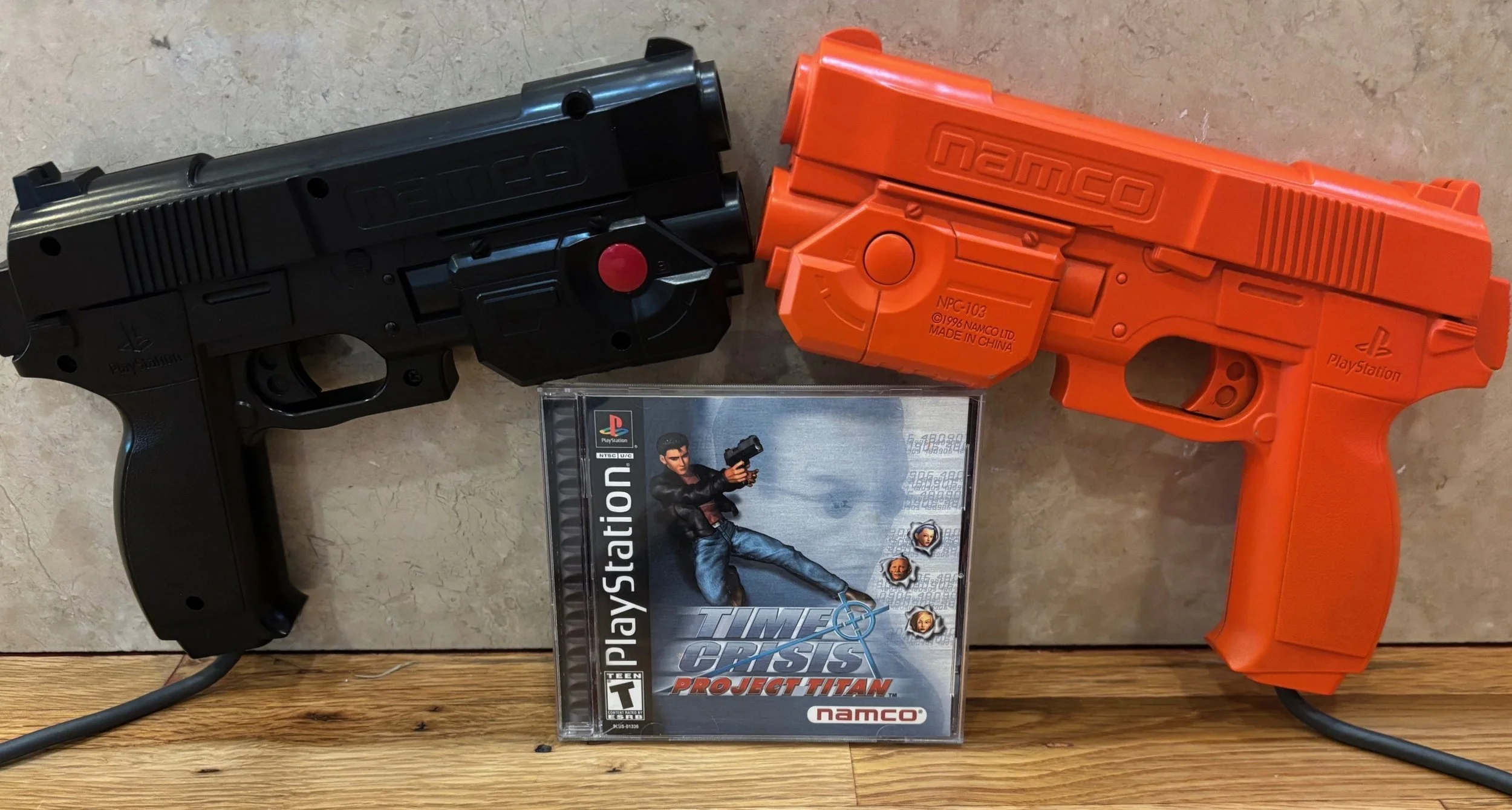
Time Crisis: Project Titan (2001)
Time Crisis: Project Titan is a title that marks a few firsts in the series, including the fact that it’s the first game that was a home console exclusive which never saw an arcade release, plus it marks the first time that a game in the series was co-developed with a team outside of Japan. The results are a very impressive entry that, despite coming out long after the PlayStation 2 had already launched and still being launched on the PS1, ends up surpassing the original Time Crisis game in many ways.
Story wise, the game is set as a direct sequel to and takes place just a few months after the events of the original Time Crisis, with Richard Miller being sent to investigate a ring of arms dealers and terrorists who were featured in the Special campaign from the PS1 port of TC1. The story is fairly inconsequential, but the gameplay is excellent, managing to feel tighter and more fun than the original, and also makes the GunCon controller feel much more accurate than in the TC1 port on PS1, since they had an additional 4 years since that port to perfect the compatibility between the software and hardware.
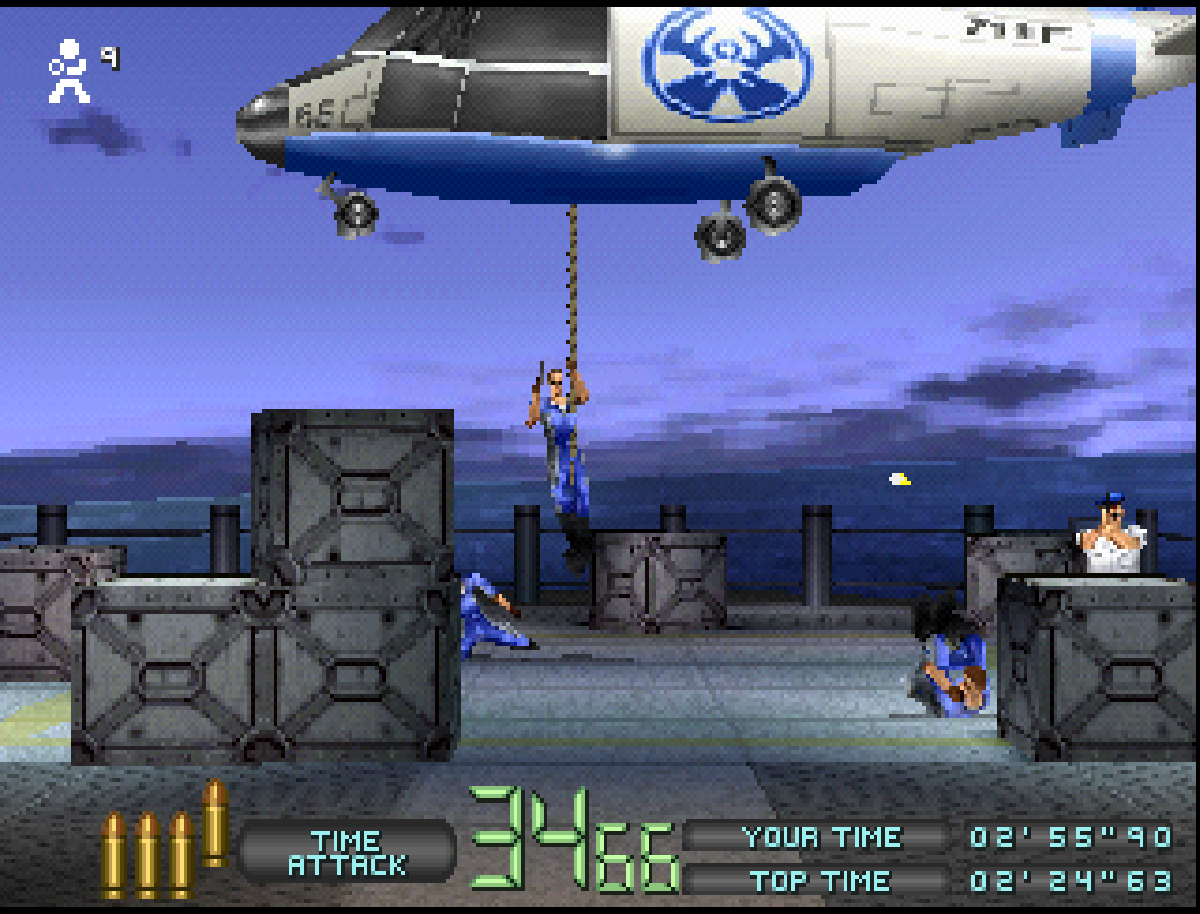
The length of the game is even longer than the arcade Time Crisis, making it feel like a wholly worthwhile addition to the series, and one that doesn’t betray its origins as a simple and speedy arcade series. By maintaining the quality and relative simplicity of TC1 or TC2 and not adding any extra weapon options, Titan stayed much closer to the fast-paced, accuracy-focused arcade style gameplay.
Project Titan stands as what I personally consider one of the heights of the franchise and a game that’s definitely worth seeking out if you enjoy the gameplay of the first two Time Crisis games and are looking for more of it.
Time Crisis 3 (2002)
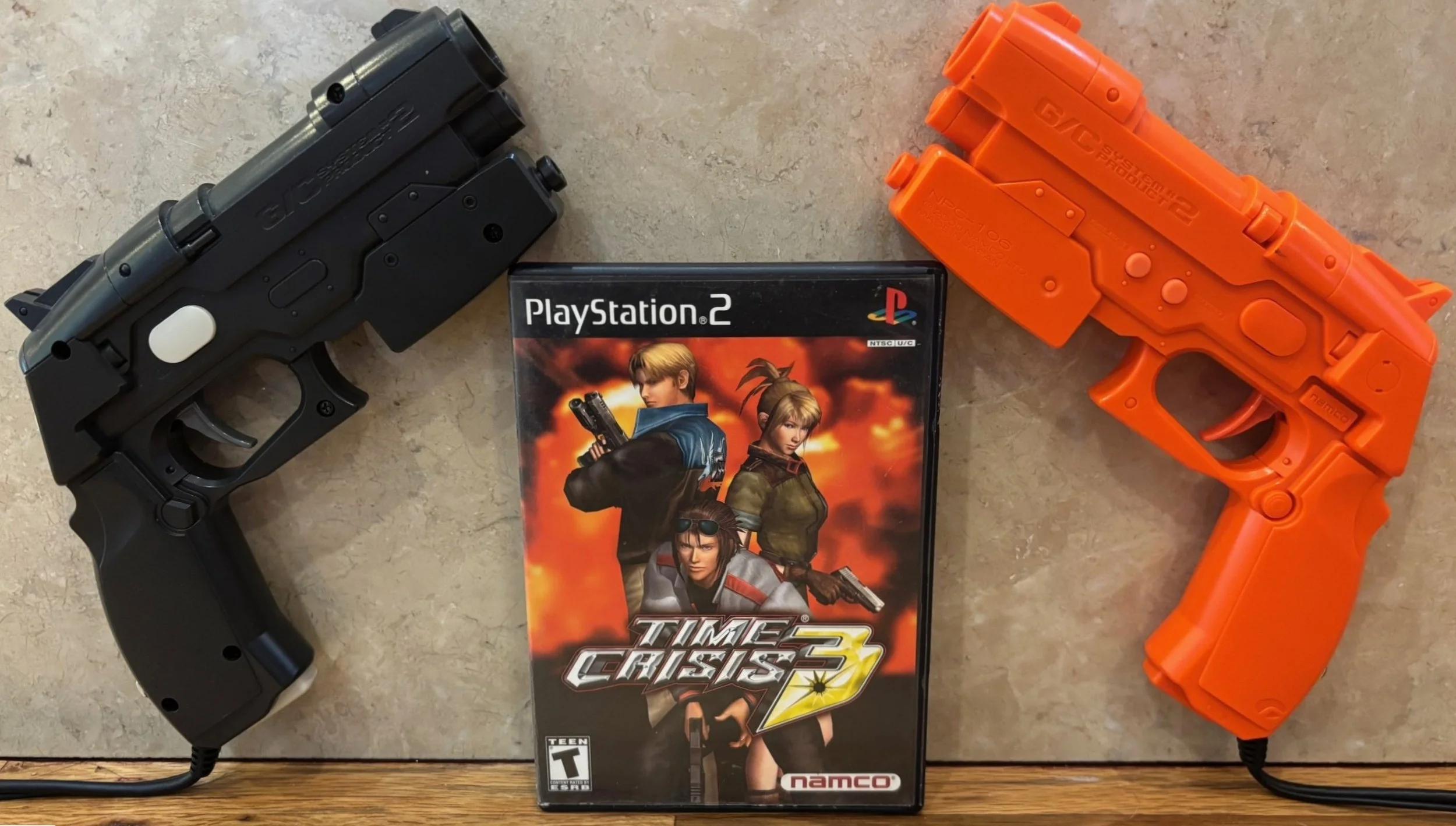
Time Crisis 3 marked a shift in the focus of the series in some ways, despite being similar to a combination of TC2 and Crisis Zone, since it’s the first arcade title to feature multiple selectable weapons, making the gameplay more complicated in many ways. This resulted in a game that attempted to move the series forward, but ended up changing some of what made the earlier games so great, making the final product feel lesser than the previous entries.
TC3 does run on a newer arcade board than the previous titles, making the visuals a bit more advanced and allowing for some more impressive set pieces than before, but the game also felt a little long and meandering in length, as opposed to the faster pace of the previous games.
The addition of the extra weapons in its initial design meant that there was a lot more to think about and adjust to in each encounter, since some weapons were more effective on certain scenarios or bosses, and the weapons having limited ammo meant you were also constantly taking inventory of your remaining shots with each gun. The weapon switch command was controlled by pulling the trigger while in cover, which ends up being fairly awkward and slows down the pace of the game quite a bit.
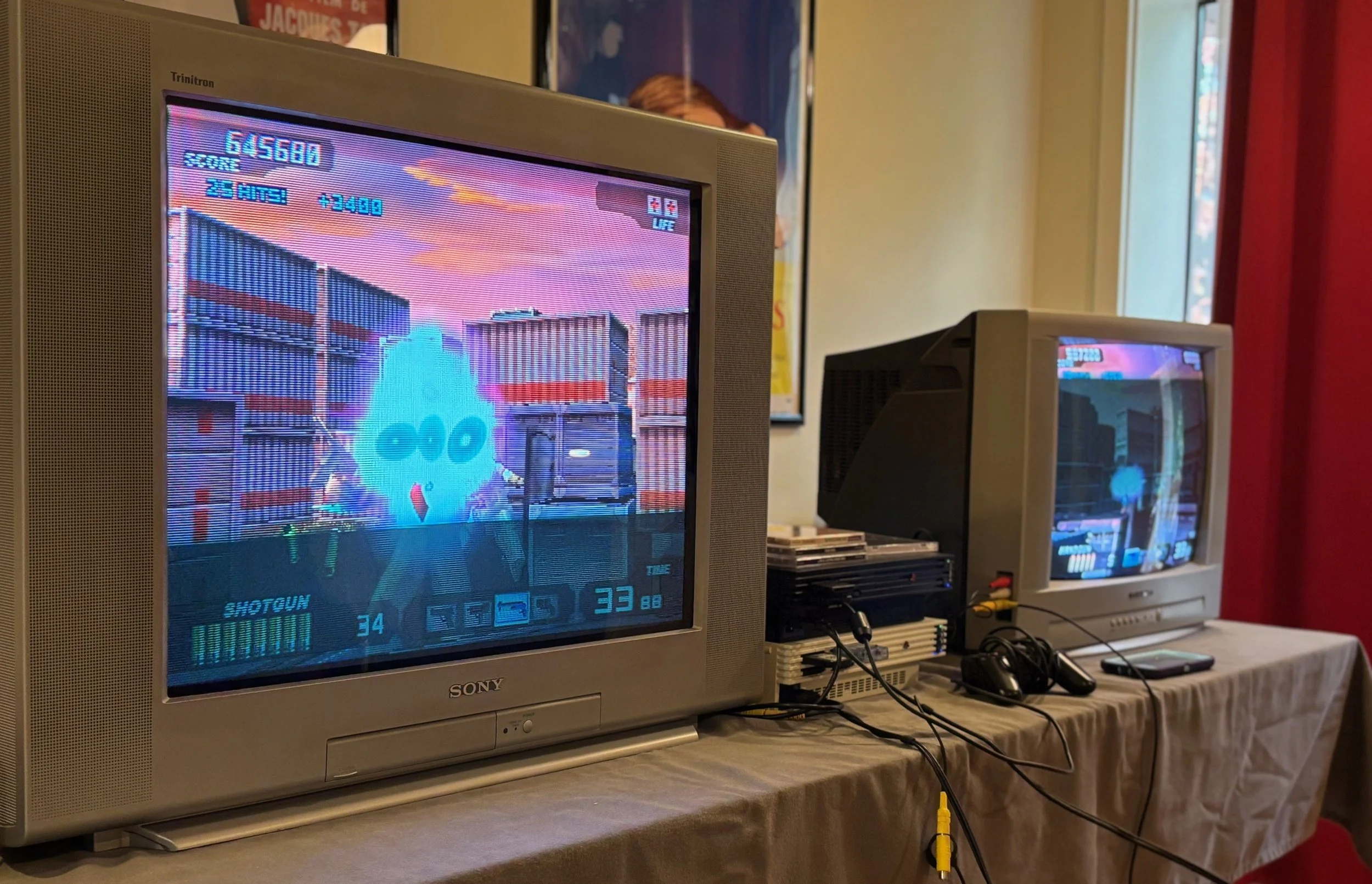
Dual screen co-op play in TC3’s PS2 port.
A PlayStation 2 port was released just 8 months after the arcade release, which was much faster than any of the previous ports, mainly due to the fact that the arcade system that the game runs on was Namco’s System 246, which is just a slightly modified PS2, making the porting process easier and faster than ever. Similar to TC2’s PS2 port, this version also allowed for co-op play with the use of two consoles, two TVs, and the link cable, and it added the Crisis Mission mode, plus a few extra gameplay segments as Alicia in the main game that weren’t in the arcade version.
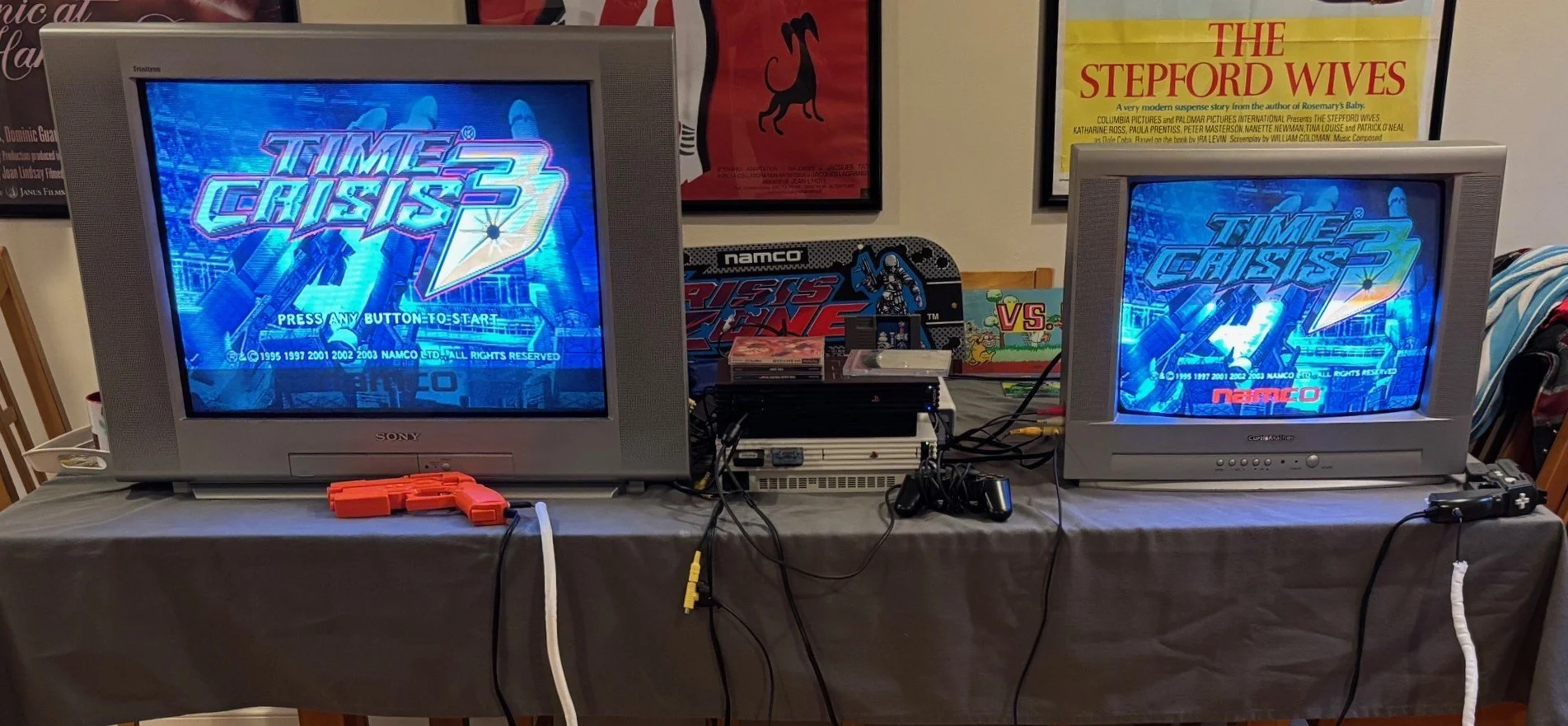
More of the dual screen co-op setup for Time Crisis 3.
Aside from those changes, there wasn’t much added to the port in terms of extras, and there were no visual upgrades like the TC2 or Crisis Zone ports, since it is running on a console that’s essentially identical to the arcade system. It’s not nearly as robust of a package as those previous ports were, plus the main game has its fair share of issues overall, so this is one of the weakest main installments in the franchise, even though it’s still fun to play.
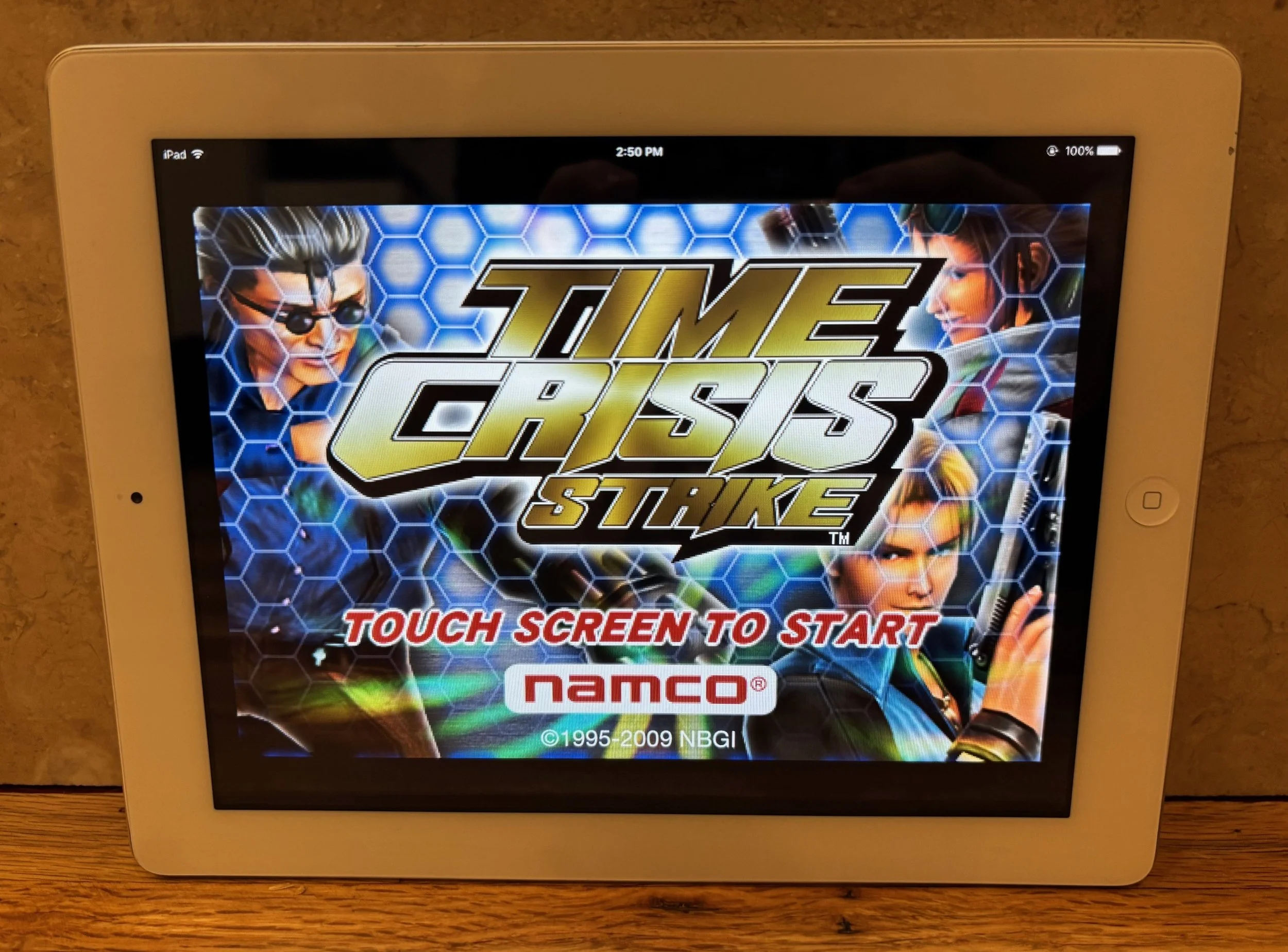
Time Crisis Mobile/Time Crisis Strike (2005/2009)
The mid-2000s was the first time when gaming on cell phones started to gain some prominence, and many of the big game publishers wanted a share of that emerging market, so they got to work porting or creating new games in their existing franchises to tempt people into the world of mobile gaming. Naturally, Namco was one of those players, releasing Time Crisis Mobile in 2005, which acts as a side-story of Time Crisis 3, featuring some of the locations and characters from it, but the first version of the game, built in Java language for older flip phones, is a very simplified and stripped-down version of the series’ gameplay formula.
This version arranges the screen into nine squares and uses the number keys of the phone to correspond to each square, so you’ll need to press the right number on the phone keypad to shoot the enemies in that square, then the zero key to take cover. The look and feel is a very low-poly 3D aesthetic, with very low quality models and textures, and a framerate that leaves a lot to be desired, but the gameplay is still fairly fun.
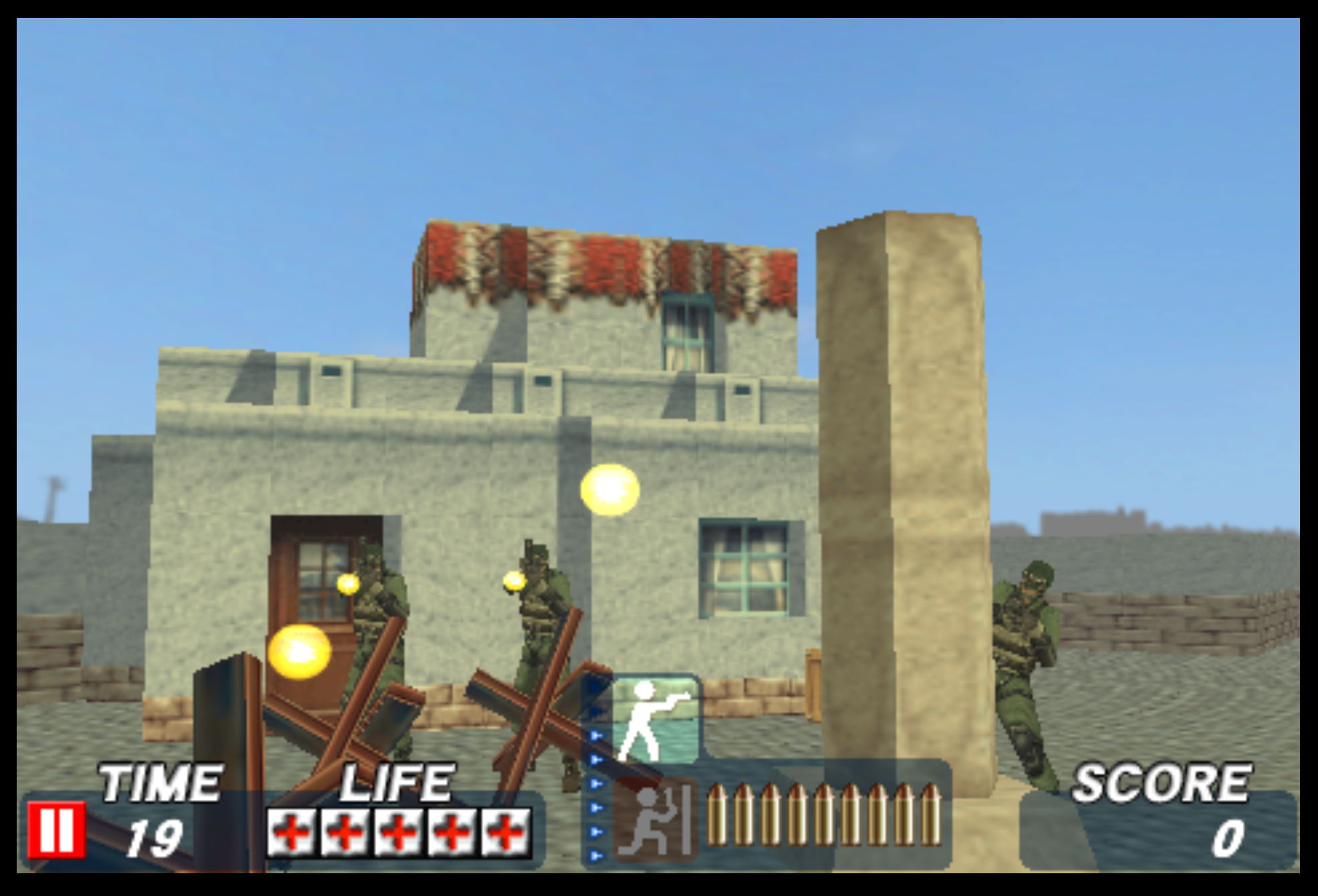
Time Crisis Strike gameplay from the iOS version
Time Crisis Mobile ends up being a very short experience, amounting to just over the length of a single stage from the main TC games, at around 10 minutes long for the entire story mode. It runs at low framerates compared to a main series game, making for quite a sluggish experience, comparatively, but one that’s still fairly adequate in the realm of mobile gaming of the era. Despite being a side story to TC3, TC Mobile retains the classic gameplay of TC1, 2, and Project Titan, with only a handgun at your disposal, which keeps it relatively simple and feels closer to the classic Time Crisis experiences. Mobile also has a Crisis Mission mode for some extra gameplay, but it only has five missions for that mode, as opposed to the usual 30 or so in the console games.
A few years after the release of the game for older flip phones, a port was created for iOS and Android, called Time Crisis Strike, which ran on the older iPhone, iPad, and Android models of the late 2000s, and featured a slightly higher framerate with touch screen controls for a more authentic light gun-ish experience. This updated version played much better overall, with the one exception being that there was no way to have an on-screen or physical button for the cover mechanic, instead having you tilt the entire device forward or backward, making the relatively inaccurate gyroscope control the cover instead.
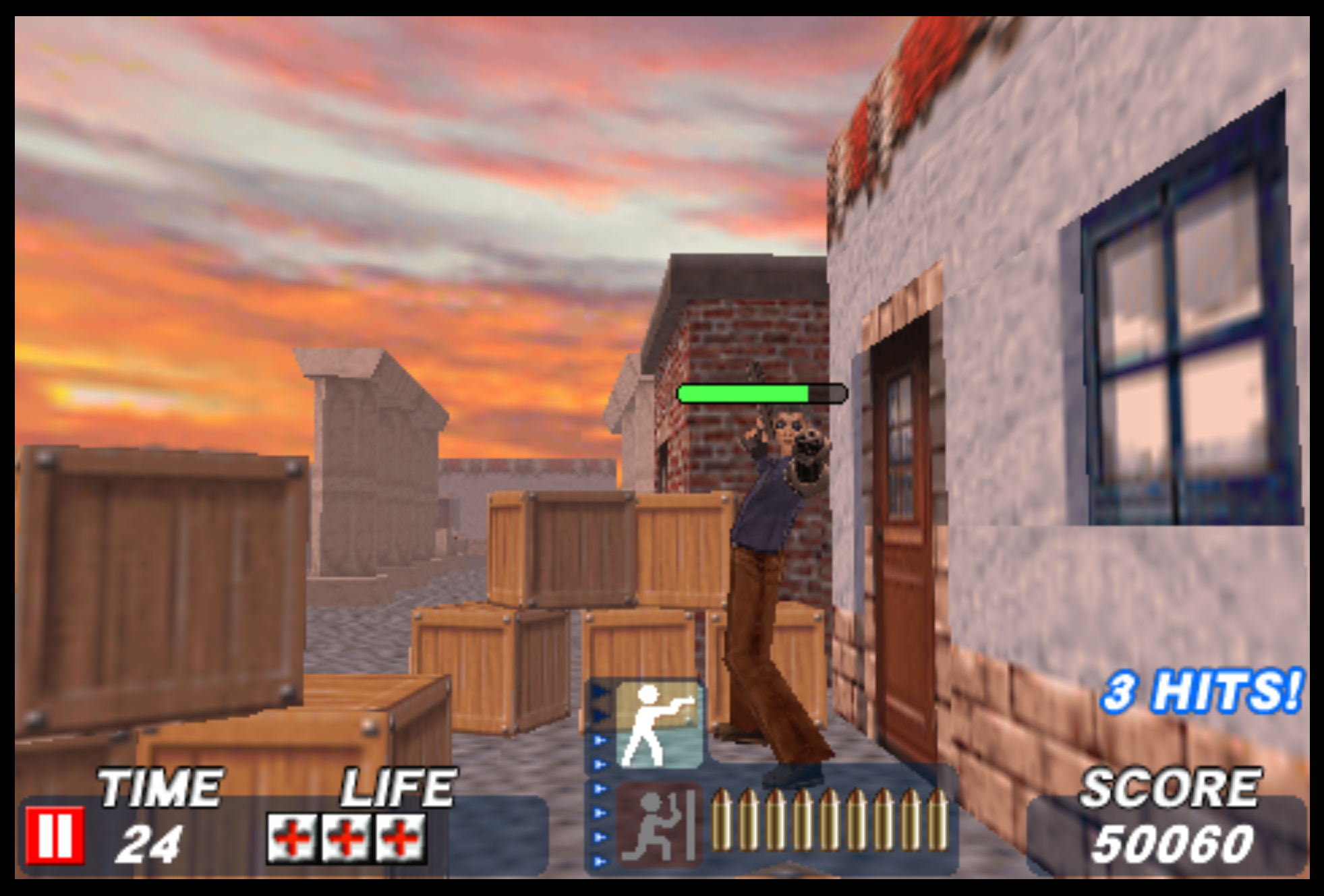
Time Crisis Strike gameplay from the iOS version. Wild Dog is here, obviously.
One of the major downsides of mobile gaming is that the games become obsolete and are often made unavailable to purchase or play after a fairly short time, since the mobile device market is constantly packing in planned obsolescence to the hardware, and many of these games are becoming lost media as a result. Even though barely anyone has the devices to play these games natively anymore and you can’t buy them officially, there have thankfully been some preservation efforts of the games by fans, and emulators developed to be able to still experience the games with relative accuracy, even if they’re not perfect.
It’s hard to say that this game is particularly worth revisiting due to its shoddy controls/performance on either version, its very short length, and how difficult it is to get the games working on original hardware or emulators, but it’s still an interesting piece of history within the series.
Time Crisis 4 (2006)
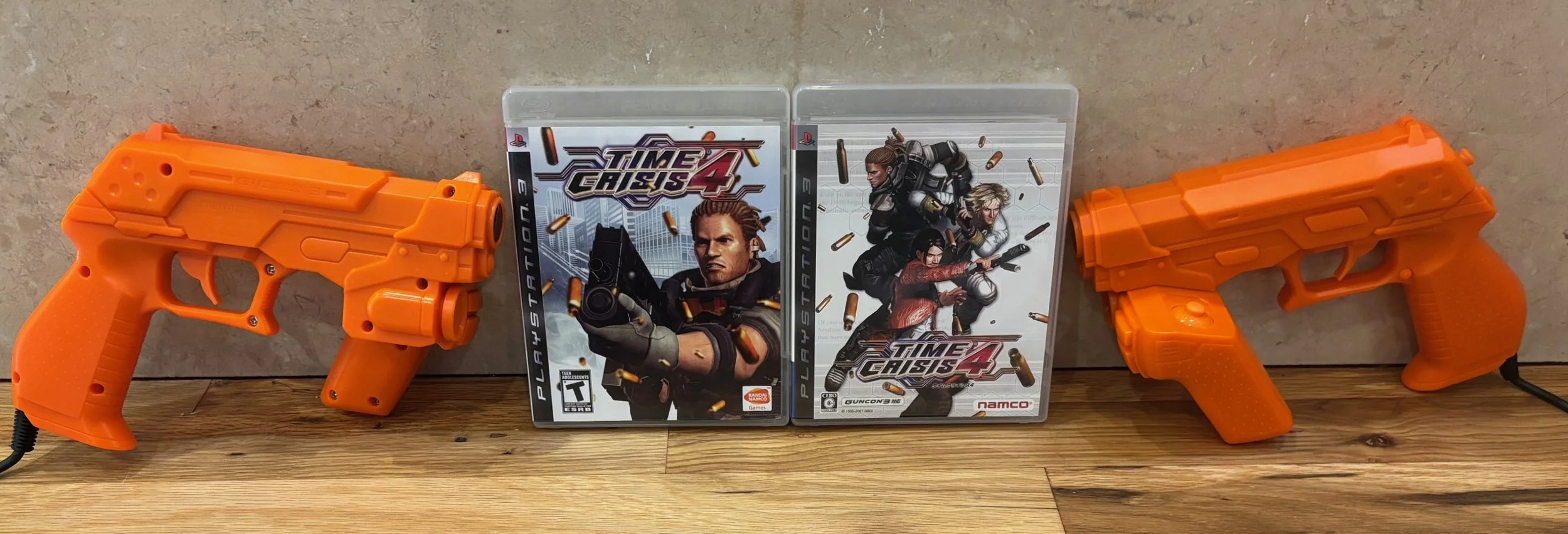
After Time Crisis 3, Namco’s approach and tone of the series changed to some extent, and Time Crisis 4 was the first time it felt like a true tone shift to match some of the gaming trends that had emerged in the mid-2000s. TC4 embraced the popular aesthetic styles and tone of the era, with gritty, Western war-centric themes and muted brown color palettes, offensively dumb characters, and all kinds of ignorant post-9/11 pro-American sentiment. Not surprisingly, it was also the first Time Crisis game that was set in the United States.
While the two main characters are treated as “outsider” V.S.S.E. agents called in to assist with a US Army mission, and they’re some of the silliest anime trope characters you’re likely to see in any game from the era, the whole theme and story of the game that surrounds them is heavily inspired by the massive popularity of the muscle-bound, macho Western military heroes that plagued the games and film industries at the time. In the wake of series like Call of Duty and Halo quickly rising to market dominance in the early 2000s, it was pretty clear that Namco wanted to appeal to this market of gamers while not truly understanding the market itself or the culture it came from. While this doesn’t ultimately affect the gameplay itself much, it makes the veneer of it feel much less fun and tongue-in-cheek, as most of the series before it was.
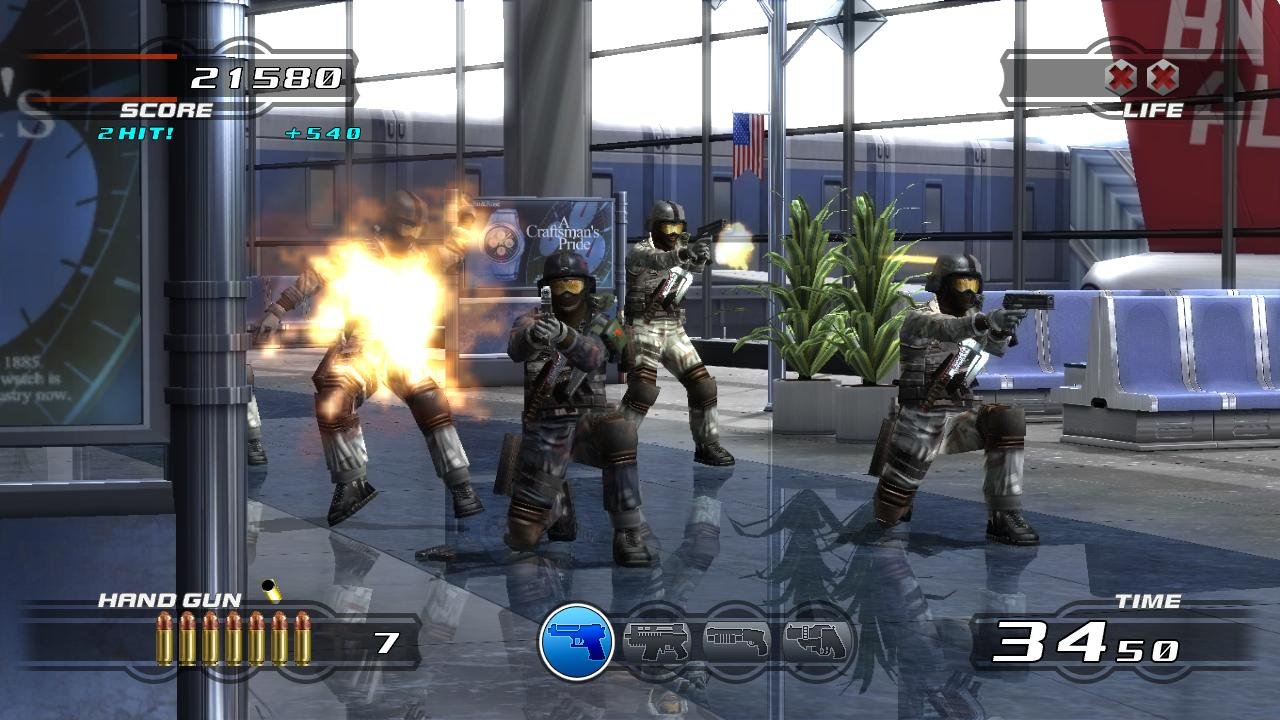
Time Crisis 4 gameplay from the PlayStation 3 port.
The gameplay ends up feeling awfully close to Time Crisis 3, mostly in negative ways, with constant weapon-switching being required to progress smoothly past certain points in the campaign, and hearing the constant military jargon thrown around in between nearly every movement you make gets tiresome pretty quickly. There’s also several segments where you’ll be forced onto a mounted turret with infinite ammo for a short time, bringing in yet another popular Western video game trope of the era, and these sections work even further to make this feel unlike the rest of the Time Crisis series.
TC4 was ported to the PlayStation 3 about a year after the arcade release, which came packaged with Namco’s new GunCon 3, and it improved the visuals over the arcade version, plus adding some new modes, including a Point Blank-like mini-game mode and Crisis Mission mode. Beyond the silly aesthetics, setting, and dialogue that plagued the original game, this port also included an entirely new first-person shooter mode that adds in several new levels to fill in the story gaps in the arcade campaign.
This mode oddly ends up including the arcade stages into its length, and they play exactly the same as they did in arcade mode, they’re just mixed in between several of the new first-person levels that are aiming to capture the popular and soon-to-be-oversaturated FPS games market of the era. The change between the on-rails arcade stages and the manual navigation of the new FPS stages is jarring to say the least.
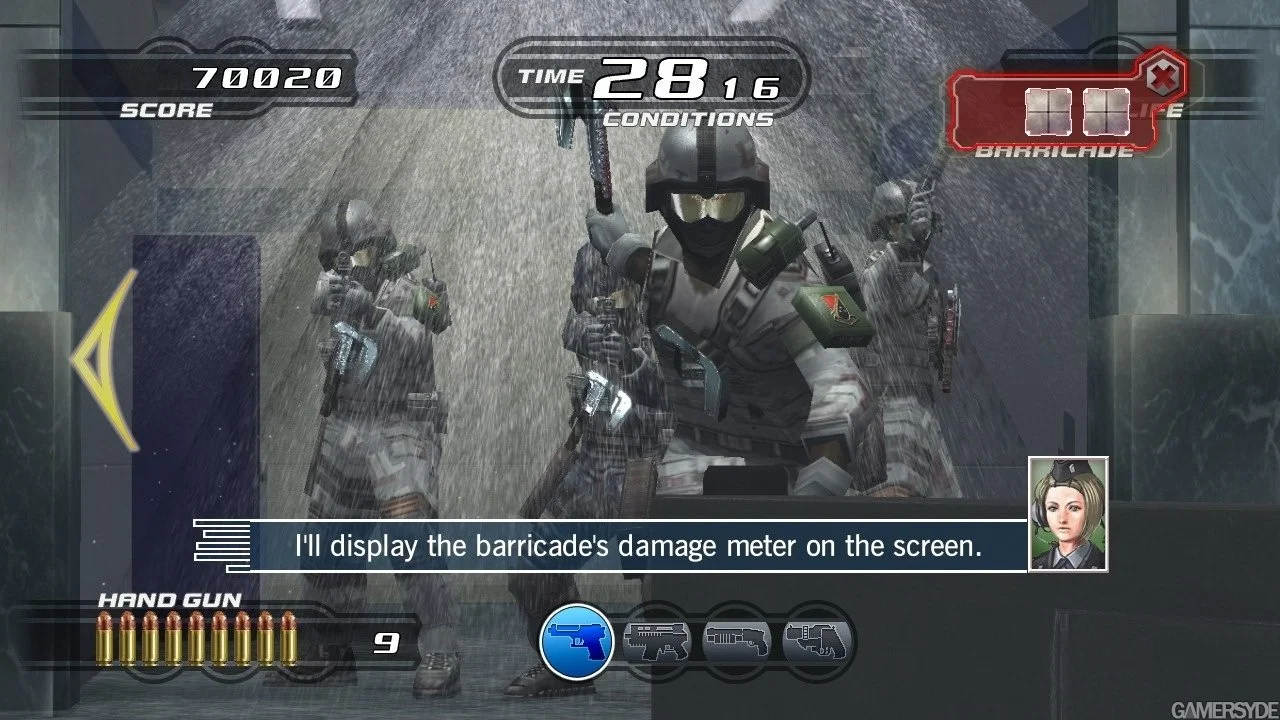
Time Crisis 4 gameplay from the PlayStation 3 port.
These new stages require you to use the GunCon 3’s normal aiming along with its dual joysticks to manually navigate some rather boring and confusing environments, and while it is interesting to see some of the environments from the arcade mode being fully explorable in this mode, the controls are not very intuitive. While you are able use a regular PS3 controller for this mode, it’s somehow even less intuitive than using the GunCon 3 and I’d highly suggest not even bothering with this method.
If you thought there wasn’t already enough cringe-inducing military banter in the arcade mode, this FPS mode will surely satisfy your quota for naively patriotic and propaganda-filled Western military dreck, even if it’s still through a silly Japanese lens that clearly doesn’t understand the market it was targeting and doesn’t take itself entirely seriously. As for some positives about the PS3 port, as mentioned before, the visuals were improved for this version, though that also introduces some performance issues (especially in the 2-player mode,) and the GunCon 3 is a decently accurate light gun solution compared to the few other attempts from the early HD console era.
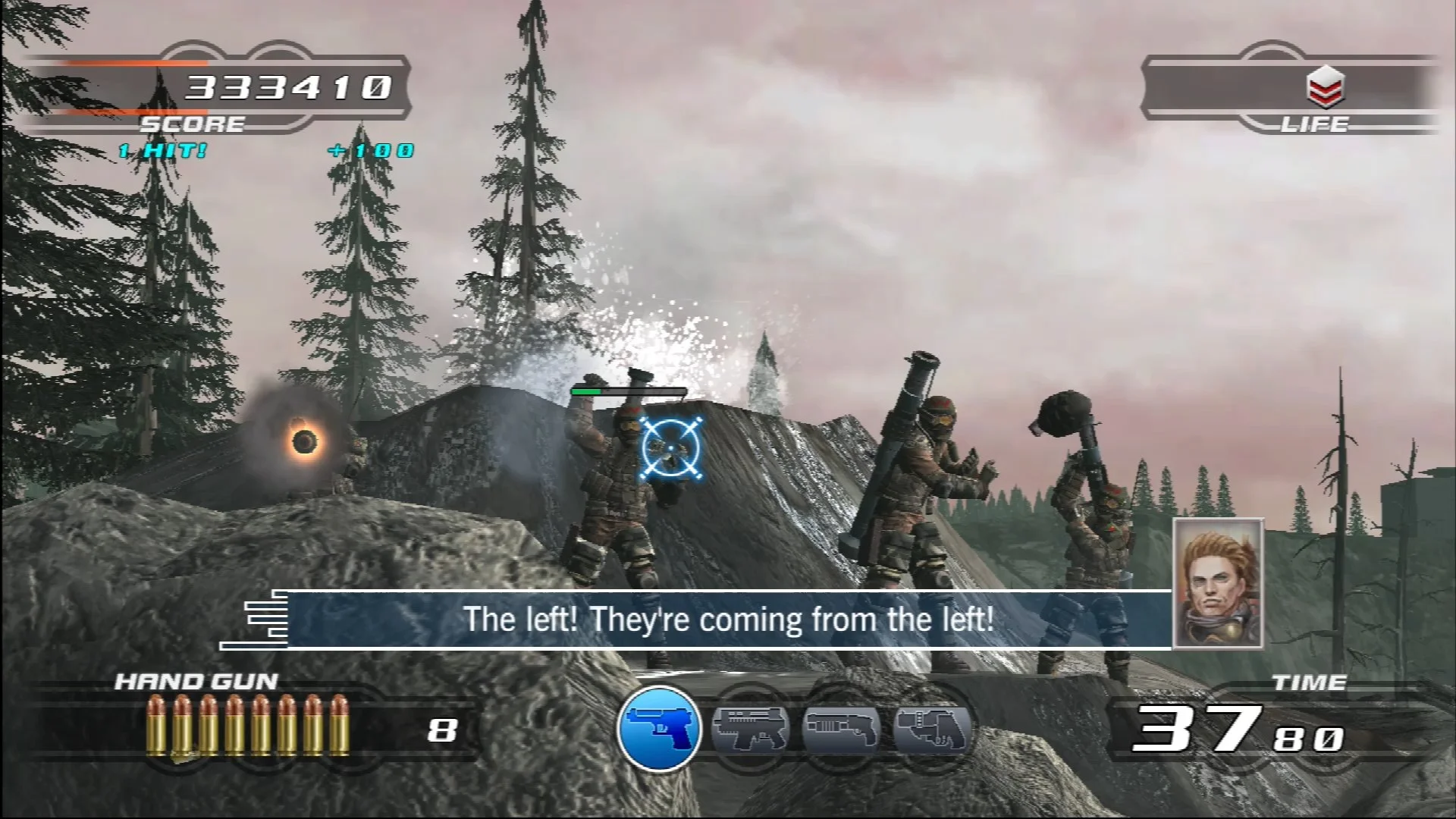
Time Crisis 4 gameplay from the PlayStation 3 port.
Namco also decided to hire a small flash game studio to create a short marketing teaser game for Time Crisis 4, which you can check out here, and it gives you just a little taste of what the main game and its aesthetics had to offer, making for a few minutes of fun with your mouse and keyboard (though it could technically be played with a PC light gun!)
Time Crisis 4’s arcade mode is still pretty fun at the end of the day if you can ignore most of the drab aesthetics and hyper-military nonsense, but feels like such a departure for the main series that it’s a bit off-putting to have it as a numbered entry. Next in the series, Namco decided to take this whole style and aesthetic even further, with Raizing Storm.
Raizing Storm (2009)
Since the military FPS genre had come to an absolute fever pitch in the three years after the release of Time Crisis 4, Namco decided to double down on its style and tone when they released the next spinoff entry to the series, titled Raizing Storm. Mechanically, this one is more of a sequel to Crisis Zone, with a similar shield reload mechanic and having a machine gun as your main weapon, but this one also includes a 2-player mode, which Crisis Zone didn’t have.
This entry takes the military shooter aesthetic much further, with constant obnoxious banter being thrown around, and even bigger, bulkier macho characters than before, but also with more giant robots and insanity, still giving it the occasional shot of anime-like silliness that lets you know it’s through the lens of a Japanese developer in small ways. However, it’s still chock full of the visual and tonal elements that make mainstream games from this era stick out like a sore thumb in hindsight.
To further fit the dumb-as-rocks Western military aesthetic of the time, Namco even managed to license two songs from the popular, generic, and military-friendly heavy metal band Five Finger Death Punch for the soundtrack of Raizing Storm, giving it that extra edge of absurdity that fit right in line with the tone it was going for.
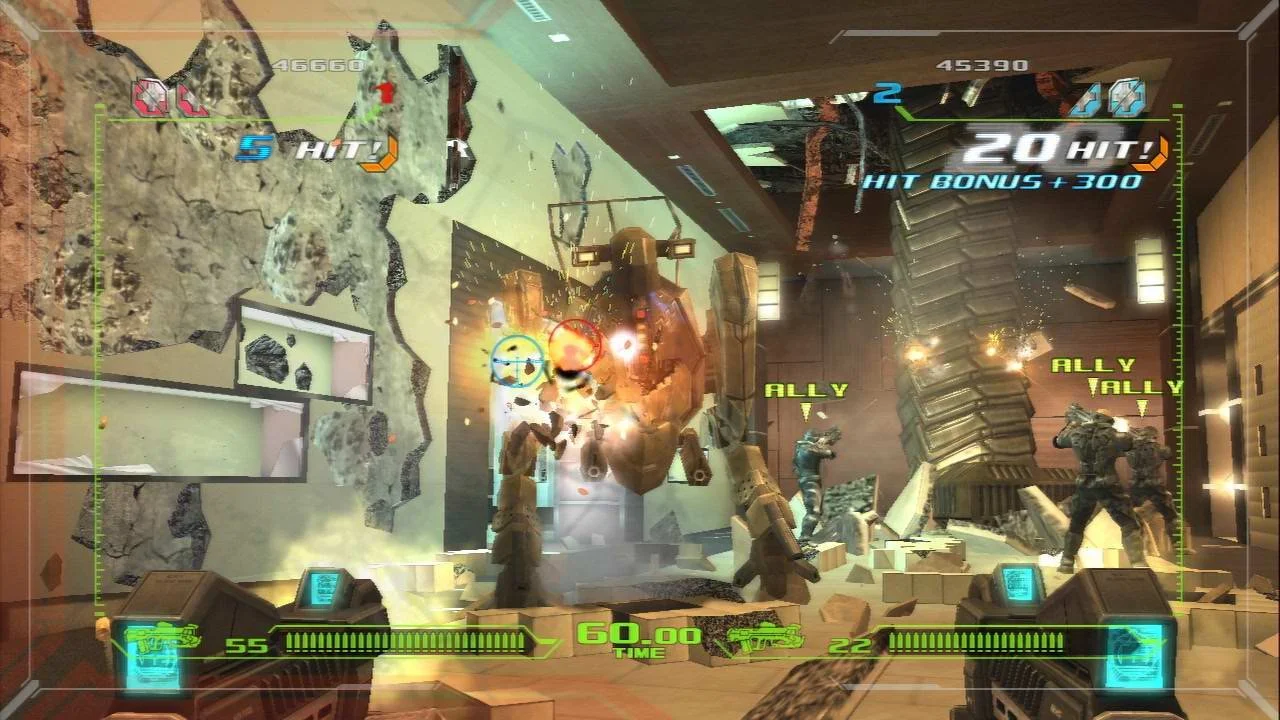
As far as gameplay, Raizing Storm also takes the over-the-top tone to new heights, as it crams as many enemies as it possibly can on screen at once, has tons of actively destructible elements in the environment, and has bosses the size of skyscrapers, but at the end of the day, the gameplay remains fairly simplistic and fun, similar to the original Crisis Zone.
There’s no active weapon switching, leaving the alternate weapons as time-limited segments scattered throughout the game, and they are quite satisfying when they arrive, making the whole arcade mode flow well, returning to the fun, quick pacing that the early series was known for. There is one small exception, in the questionable decision to keep the final stage of the game locked behind successfully completing a mini-game at the end of the third stage, and even if the final stage is fairly short, it’s a pain to have it locked under a strict performance requirement.
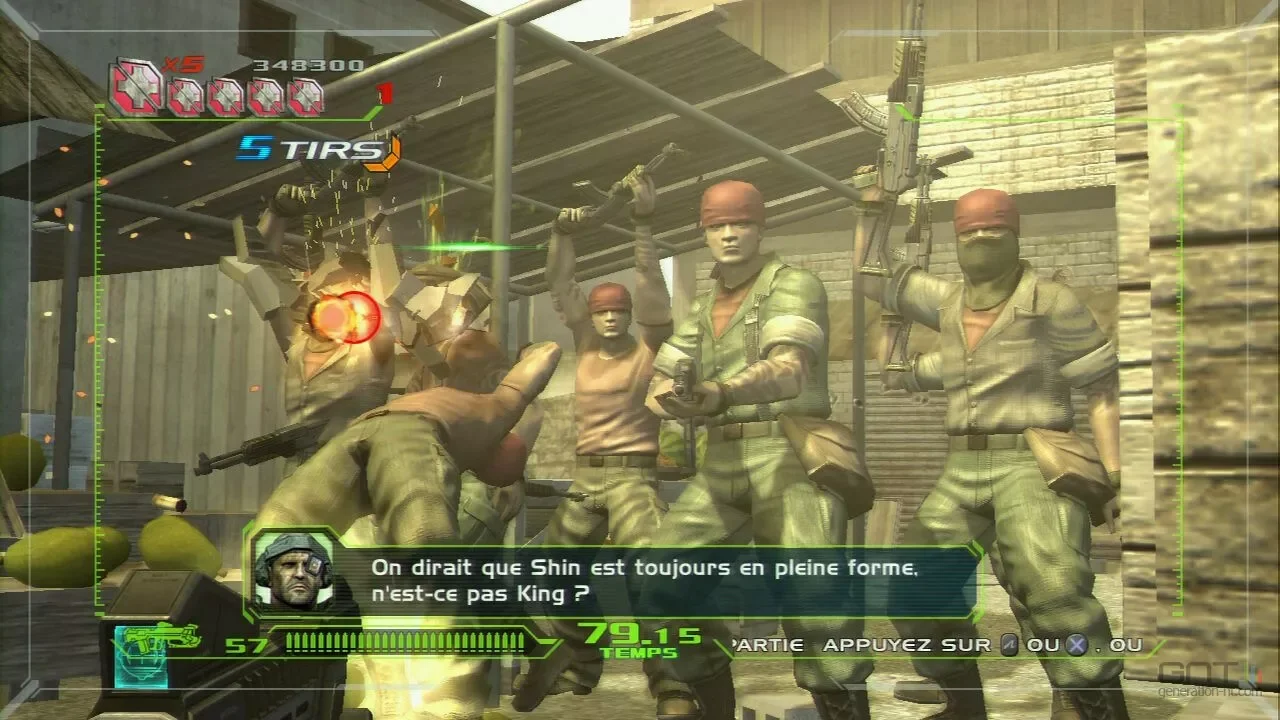
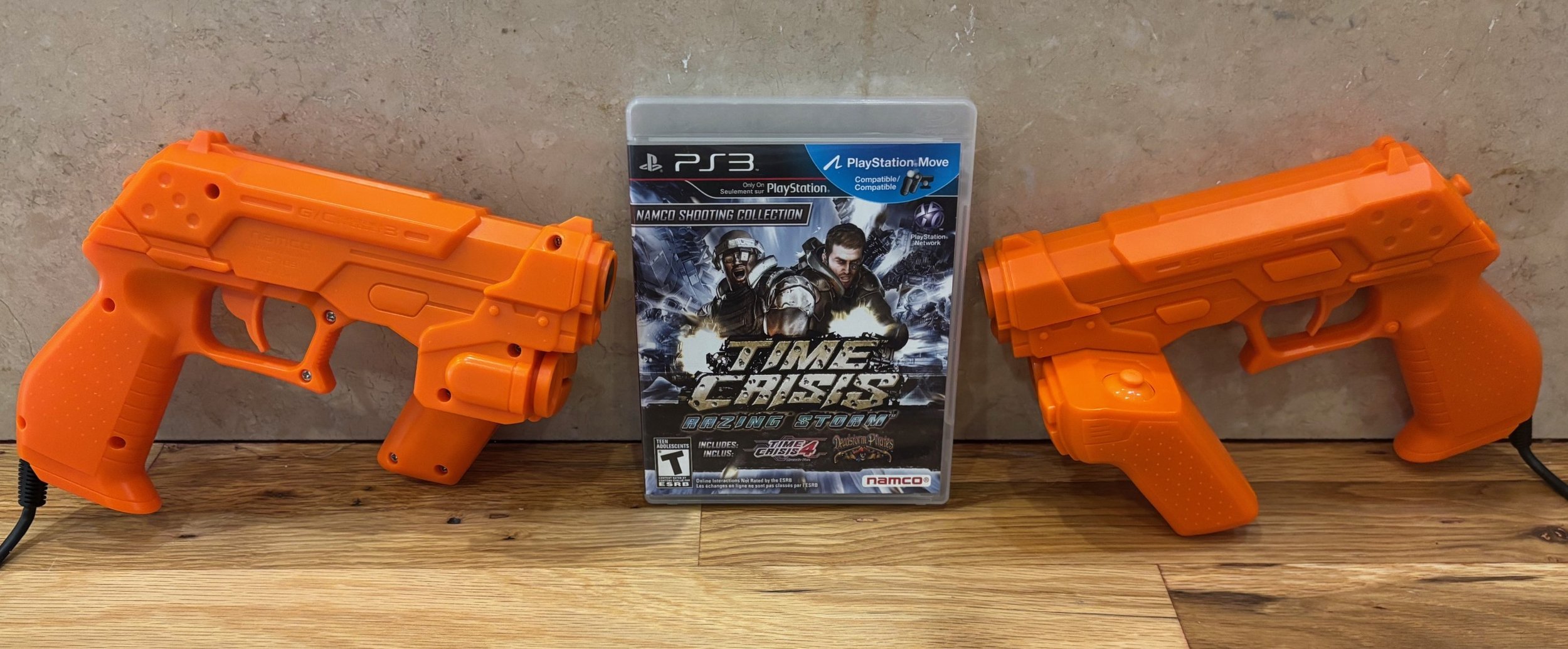
Since the arcade version of Raizing Storm ran on Namco’s System 357 board, which is just a PlayStation 3 inside an arcade cabinet (similar to how the System 246 was a PS2,) a PS3 home port was a bit of a no-brainer here and came just one year after the arcade release. However, they decided to go a little bit extra with this version, since they also bundled it with the arcade mode of Time Crisis 4 and Namco’s other recent light gun game from the same arcade system, Deadstorm Pirates, on the same disc. New modes were also added to Raizing Storm, including a pointless online battle mode which was dead on arrival, another FPS mode (similar to TC4 on PS3,) and a new mini-game mode called Sentry Mode that’s a far cry from the Crisis Mission modes of past games.
This turns out to be a great collection, having three of Namco’s light gun shooters from the era on the same disc, and it supported the GunCon 3 as well as the recently-released PlayStation Move system. Even if the Move was relatively slow and inaccurate when it came to aiming, it opened these games up to wider audiences who didn’t have a GunCon 3, and still gave the general feel of playing with a light gun. Similar to the home version of Crisis Zone, they changed the title to Time Crisis: Raizing Storm for the Western releases, and named it Big 3 Gun Shooting in Japan.
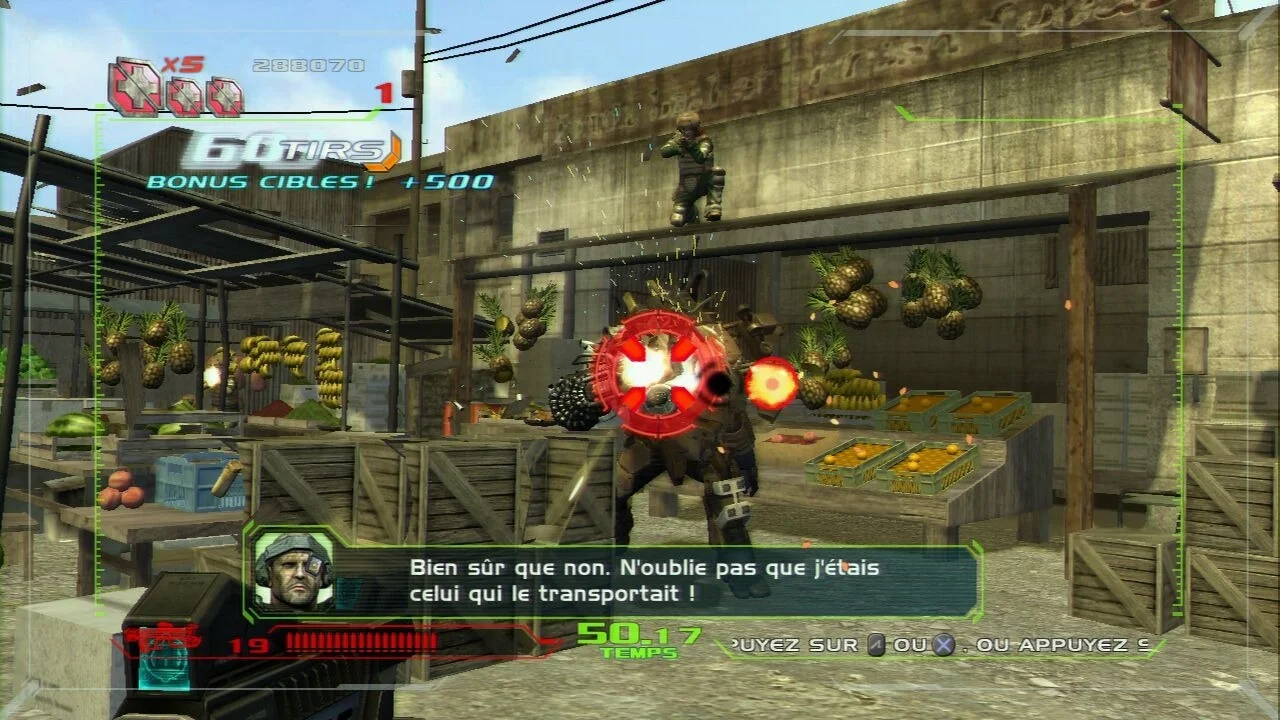
The new FPS mode that was added for the home version was ultimately a boring chore to play through, just like the one they added to Time Crisis 4’s home port, but it didn’t awkwardly integrate the arcade stages into this mode like TC4’s did, making it at least feel like it committed itself to being a full-on FPS mode. Unfortunately, Raizing Storm’s FPS mode was also significantly expanded, making for more hours of gameplay, none of which was very intuitive or engaging overall.
Along with its longer length also came a lot more insanely cringe-inducing one-liners and Western military chatter being tossed around at all times, similar to most FPS games of the era, and in general, I’d recommend not wasting your time playing through this mode unless you’re just really desperate to explore every nook and cranny of the franchise.
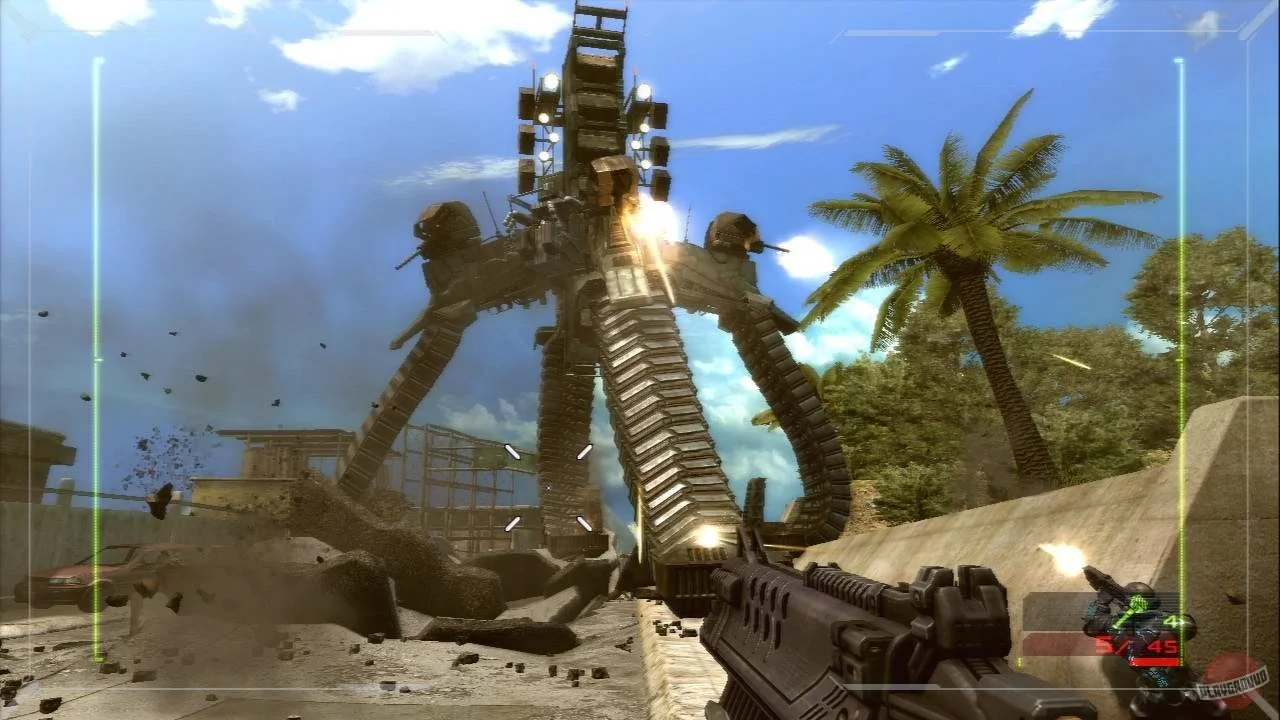
The arcade mode of Raizing Storm is still a very strong and fun Time Crisis experience if you can get past the wooden military characters and dialogue throughout the whole thing, and it’s one that should be experienced by any fans of the series.
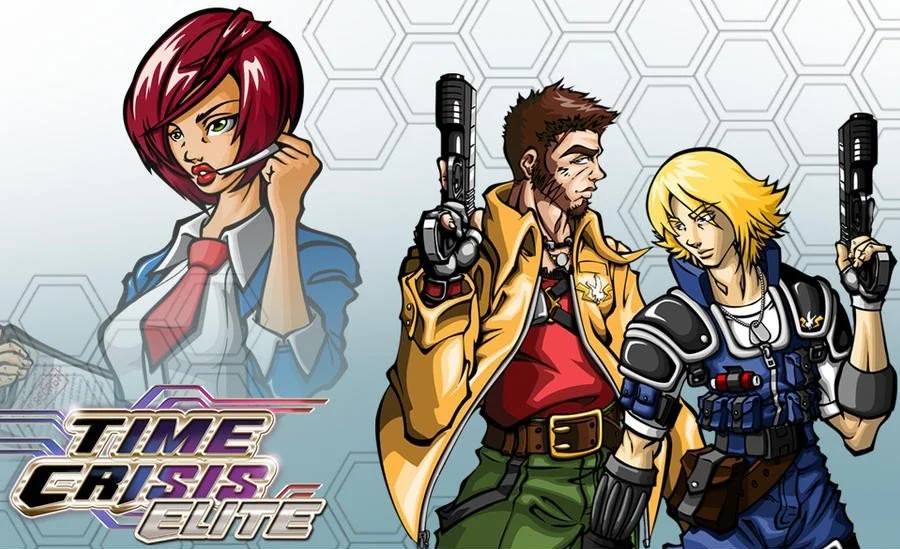
Time Crisis Elite (2009)
Towards the tail end of the 2000s, older style flip phones were starting to become less popular in some parts of the world as smart phones began their still-prominent rise to world dominance, but Namco decided to output one more Time Crisis game for the old style phones, with Time Crisis Elite in 2009. The gameplay of Elite is very similar to that of Time Crisis Mobile, where you push the phone’s number keys to shoot enemies in different grid points on the screen, but instead of using 3D visuals to be closer to the other series entries like TC Mobile did, Elite was entirely a 2D affair, for the first and only time in the series.
It’s fully developed by a European studio, which is another first in the series, so it feels quite different from the rest of the games in many ways, but is still relatively fun and follows the usual cover-and-shoot mechanics with weapon swapping. Elite is overly lengthy because of its slow running speed, doesn’t feature any characters or story threads from the main series, plus the music is extremely repetitive and annoying, but it’s still an interesting little piece of the series’ history.
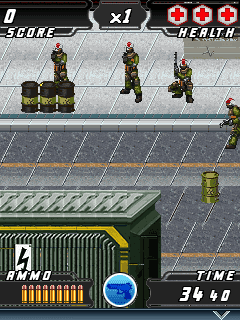
Similar to Time Crisis Mobile and the other mobile games in the series, this one is also very inaccessible now, since it was removed from digital storefronts well over a decade ago and can only be run on devices that use Java-based OS systems like the old flip phones. Unlike Mobile, this one never got a port to iOS or Android, but it can be run (with some tinkering and trial-and-error) on some mobile phone emulators for PC.
Despite not meaning a whole lot to the series overall, Elite is still an interesting piece of Time Crisis history that introduced several unique factors, but ultimately none that moved the series forward or made any meaningful impact, even though it can provide around 15-20 minutes of fun for die-hard series fans who want to track it down.
Time Crisis 2nd Strike (2010)
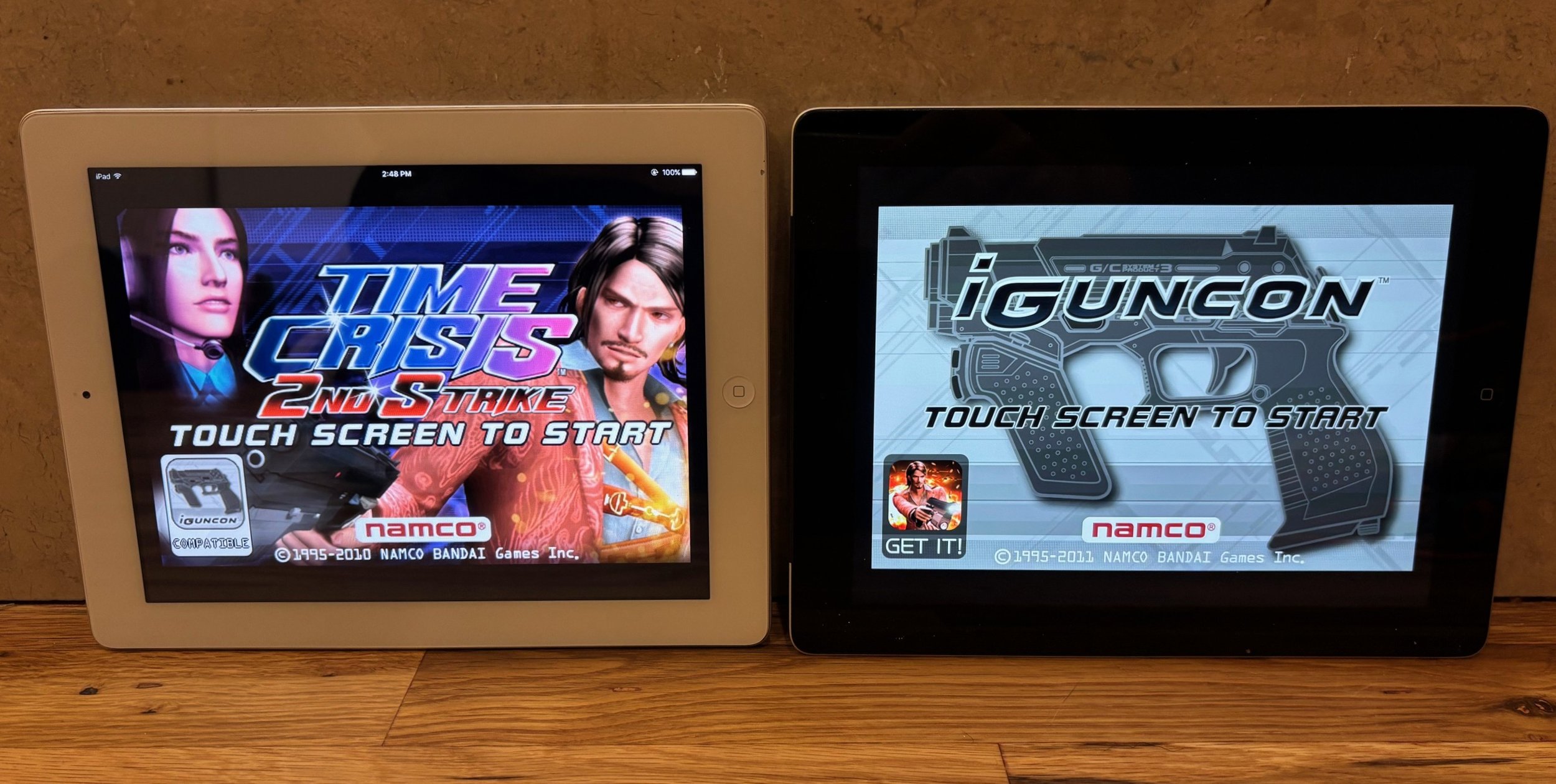
Namco’s next Time Crisis game was yet another mobile-focused game, this time being a Time Crisis 4 spinoff that was developed exclusively for iOS and MacOS devices, and it offered a unique yet clunky attempt at making the experience feel closer to using a light gun. You play as Giorgio from TC4 with the scenario serving as a prequel for the events of the main game, and unlike the first Time Crisis Strike, this one has an on-screen pedal button instead of being required to use the gyroscope to control the cover mechanic, which makes a world of difference in the gameplay.
The other unique new feature was the compatibility with another Namco app called iGunCon, which you could download and use on other iOS devices (yes, this required you to have two iOS devices in the early 2010s..) and it converted the second device into a gyroscope light gun, allowing you to control your pedal and aiming cursor with the second device instead of using the touch screen. While this was a pretty novel idea, the aiming is generally a little too slow and cumbersome to really be preferrable over just using the touch screen.
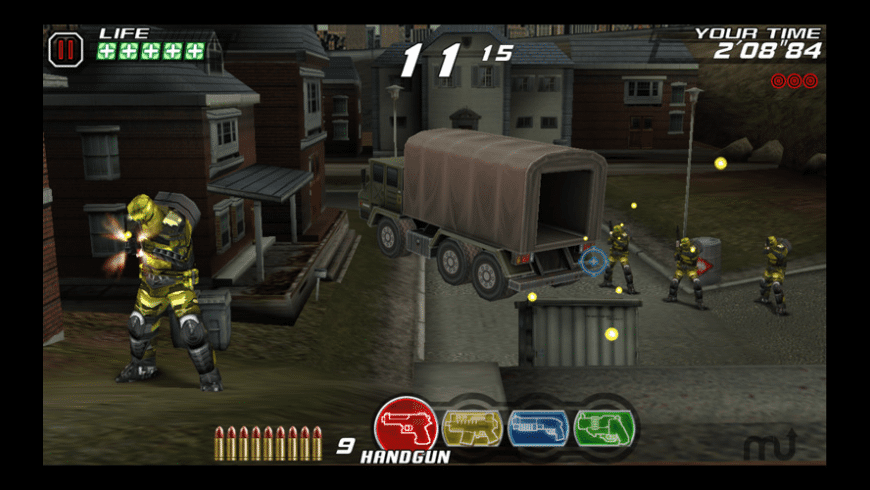
Especially considering the relative bump in difficulty compared to the first Strike game, the iGunCon gyro aiming became even less preferrable, since precision and speed are heavily required to progress through the game at all, making it also feel closer to an arcade Time Crisis experience than the first Strike game. Besides the increased difficulty, the length of the game is the full length of one of the arcade experiences, plus there’s 10 Crisis Mission stages that unlock as you play through the main game, making this a much more robust package than all the other mobile games. This is the only of the mobile games that’s quite recommended if you have a device that can run it and don’t mind jumping through the hoops to get it running.
As you might guess, the game re-uses lots of assets from TC3 and TC4, but feels right in the middle of both of them, featuring a number of fights against vehicles and bigger enemies, as well as an obligatory stage-long fight with Wild Dog at the end of the game, plus the active weapon switching just like TC3 and TC4. The game runs and plays quite well with the touch screen for a mobile game of its time, making this a fun playthrough, even if a bit frustrating to meet the time requirements later on.
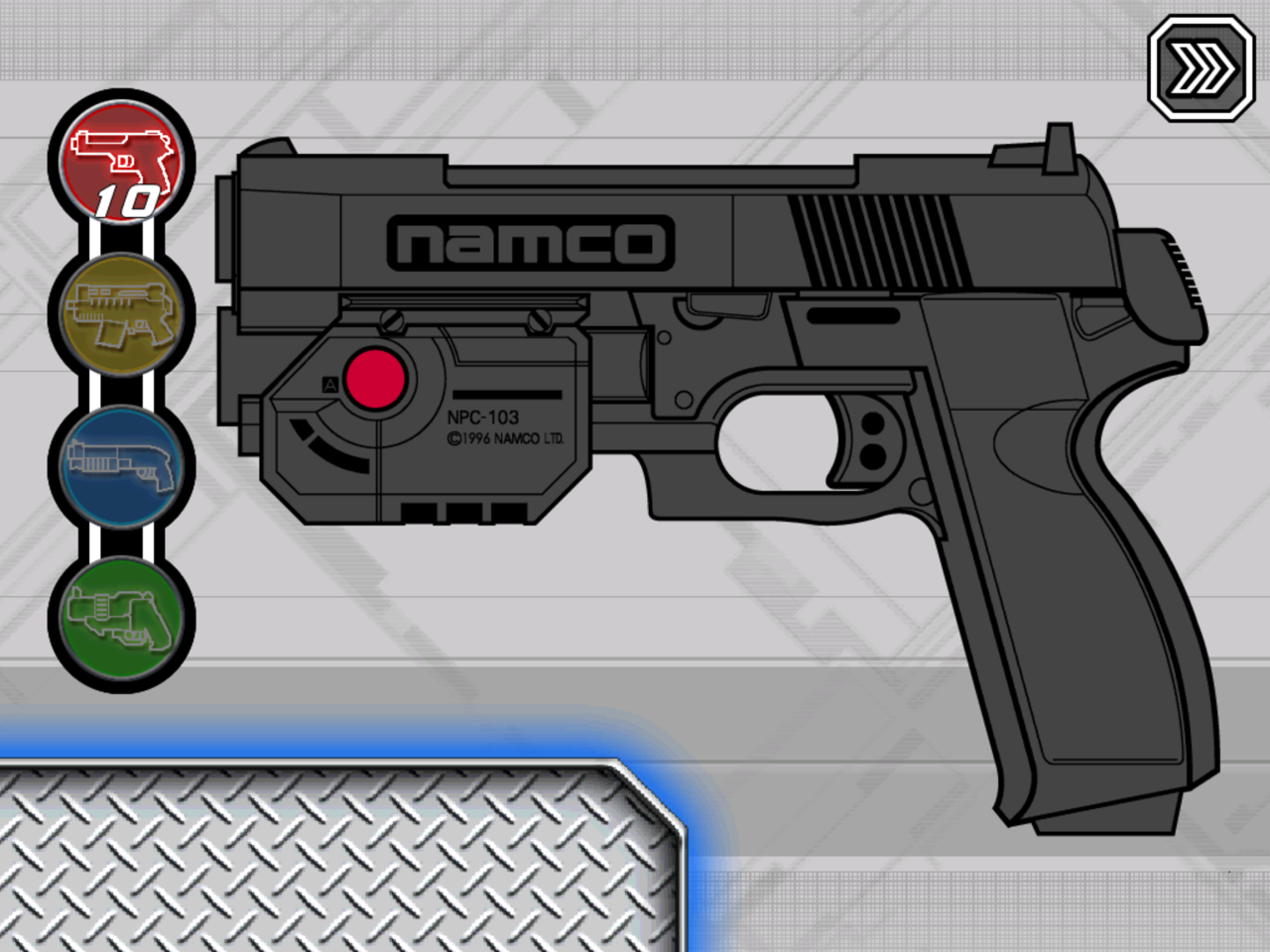
Aside from acting as a “light gun” solution for 2nd Strike, the iGunCon app also had some other novel features that cherished some of the history of the GunCon hardware series, since it also functioned as a “museum” of sorts. This mode was oddly named “Toy” mode, where you can choose between high-resolution artworks of the GunCon 1, 2, or 3, complete with different shot sounds and animations to go with it.
So, even if its functionality in using it for 2nd Strike is less than ideal, it still had a little more content in the idea, but sadly, the app was never used for any other game, since Namco never released another light gun shooter on mobile platforms. Both the iGunCon and 2nd Strike apps were de-listed from storefronts just a few years later, and then made unable to run on newer iOS versions just a few years after that, becoming yet another piece of lost media from mobile platforms.
Time Crisis 5 (2015)
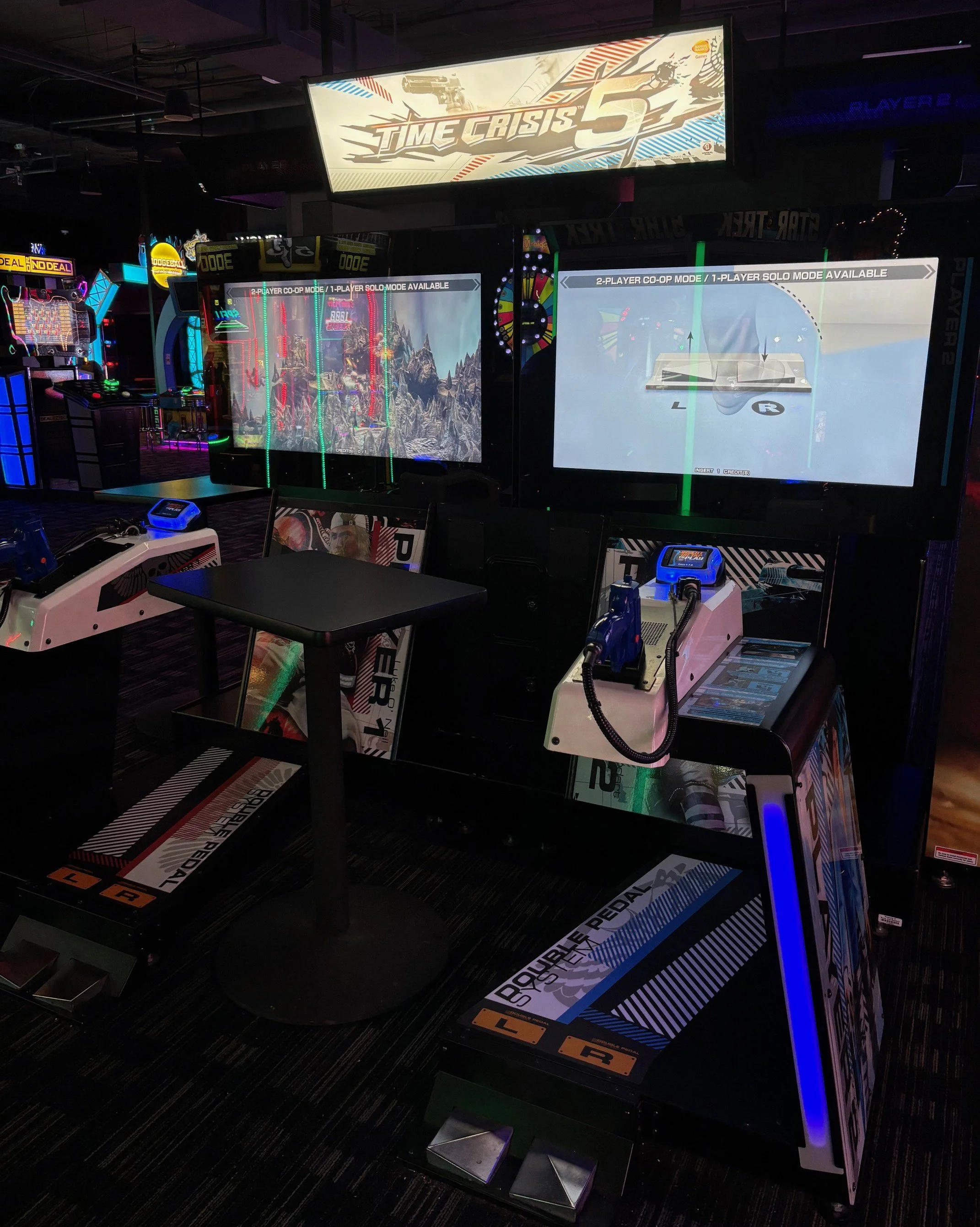
Following 2nd Strike, after five years of silence in the series (the longest lull in its entire history up to this point,) Namco finally released the next main series arcade entry in 2015, with Time Crisis 5. TC5 brought back the colorful, extravagant, action movie/anime-influenced aesthetics and gameplay from the early games in the series, even going as far as to bringing back the two characters from Time Crisis 2 as companions on your journey through the game.
Not only did it bring back a lot of the core elements from the early games to tighten up the gameplay, but it also introduced a number of new features, including two foot pedals for each player, allowing for movement between two different cover spots for each player in every scene, and a dedicated physical button to switch weapons, instead of having it relegated to the messy “shoot while in cover” command that TC3 and TC4 used for this function.
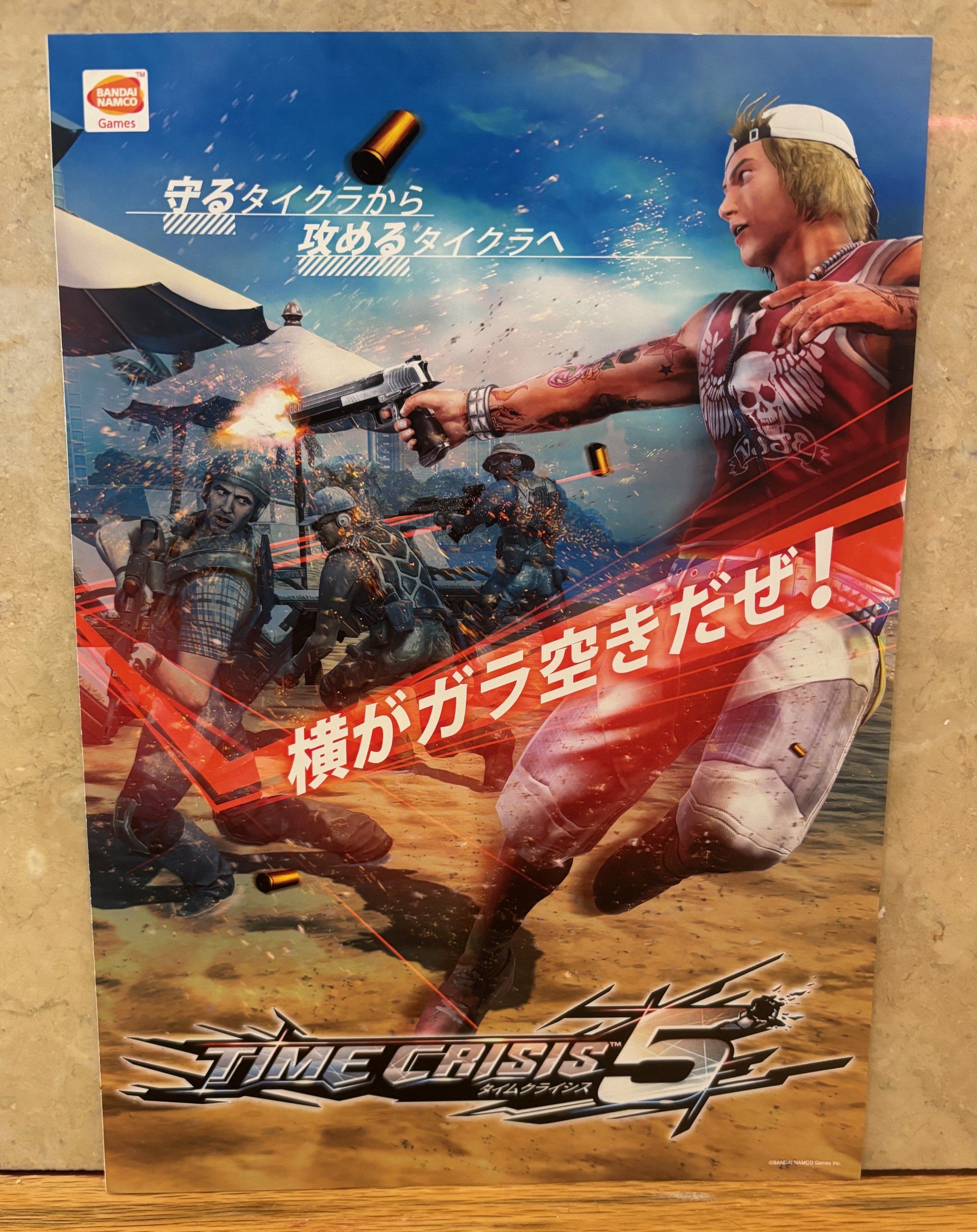
TC5’s story brought in two new absurd V.S.S.E. agents that look straight out of a Shonen Jump anime, and also brought back Robert and Keith from Time Crisis 2 for all kinds of crazy hijinks and plot twists along the way. There’s even sections that feature zombie hordes, giant mecha, mounted gun helicopter segments, and more over-the-top set pieces than ever before, bringing back many “greatest hits” moments from the previous games while also throwing in a lot of other new influences for the fun of it.
The new double cover system makes the gameplay even more fast-paced and fun than before, adding more strategy for both players to use as you shoot your way through the adventure, with many enemies requiring to be hit in the back or side to do damage, along with the ability to use the cover movement system to actively dodge attacks. Even if the tone gets very silly and light-hearted here, it’s a joy to experience, unless you’re someone who loved the overly-militaristic tone of TC4 and Raizing Storm, perhaps.
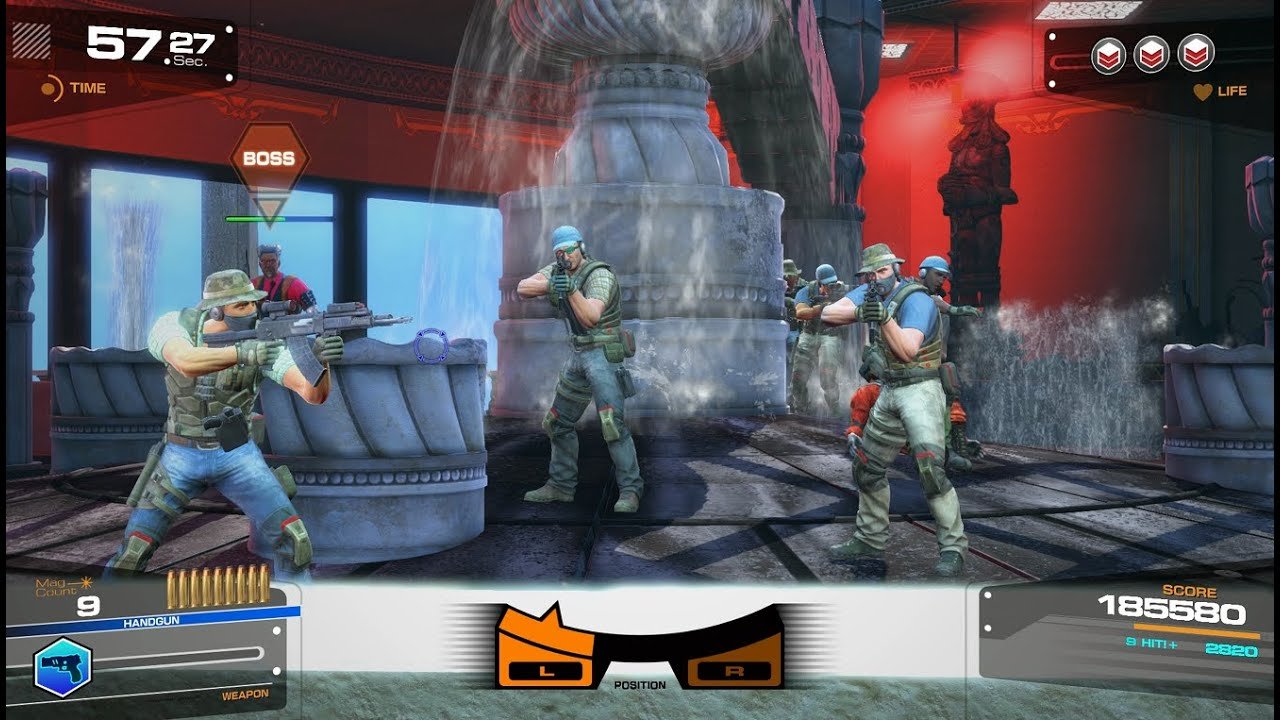
While the arcade machine initially launched with three stages to play, an update was released 5 months later, adding another three stages, with a lot more great gameplay and story, doubling the amount of content in the experience. This also makes it the longest gameplay experience in the series, not including the bloated and boring FPS modes from TC4 and Raizing Storm.
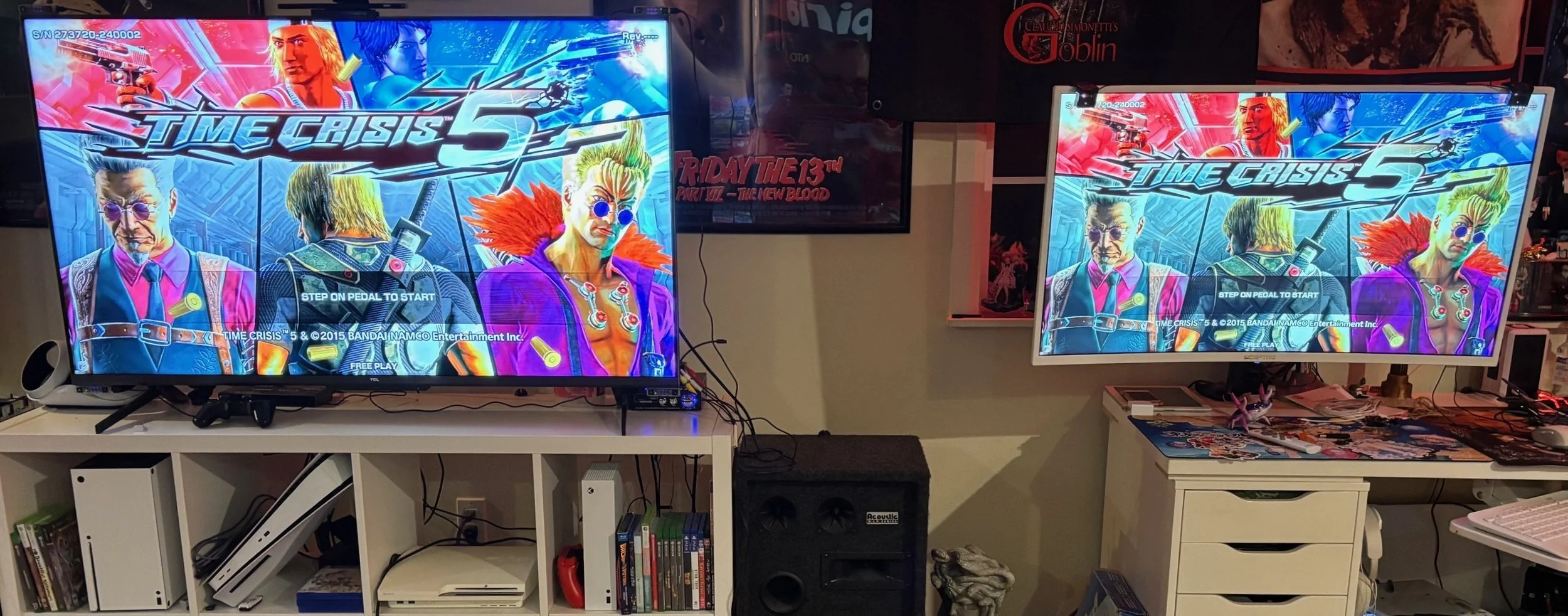
Unfortunately, Time Crisis 5 is still the only arcade entry in the series that never got a home port, and likely never will, but the game can still be found in some arcades around the world in 2025, and it can also be played unofficially on home PCs with a powerful enough gaming PC, even allowing for the 2-player co-op link mode to work with two PCs, as shown above.
Time Crisis 5 ends up being easily one of the strongest experiences in the series, celebrating the series history by featuring elements from all the previous games with several new ones mixed in, and its a real blast to play, especially with a friend. This would sadly be the final entry of any kind into the series as of 2025, and with arcades generally becoming a dying breed as of 2020, the hope of seeing another seems less likely than ever, but we can never truly say never with entertainment franchises.
It’s hard for most gaming franchises to stay active for thirty years and still have nearly every experience in the series hold up with time, but Namco has managed it with Time Crisis, which speaks to the care and craft that was consistently put into the games. Even if some of the entries had some strange design choices here and there that attempted to adapt to changing markets, the core fun of the gameplay experience remained throughout.
While the future of the series is unclear at this point, it’s nice to at least see Namco acknowledging the franchise and allowing some modern re-releases through things like the G’AIM’E light gun system in 2025. Hopefully this will mean more chances to keep the series alive in various forms, even through the uncertainty and diminishing popularity of arcades as a whole and the reluctance of developers and users to invest in modern home light gun solutions.
Stay tuned for more light gun series retrospectives in the future as well as a 2025 year-end wrap-up very soon, and let us know which Time Crisis games are your favorite experiences in the comments or through the social platforms!